How Salvage Yards Are Wasting Hundreds of Hours Manually Listing Auto Parts Online

In 2026, the automotive recycling industry is rapidly shifting toward AI-powered ecommerce operations, multi-channel marketplace selling, and automated inventory distribution.

Buyers no longer call salvage yards asking if a part is available.

Today’s customers search online across:

But while online demand has exploded, many salvage yards and auto recyclers are still relying on manual listing workflows that waste hundreds of operational hours every month.

The result?

The inventory already exists.

The demand already exists.

The real bottleneck is the workflow.


The Hidden Operational Problem Inside Most Salvage Yards

Systems like Pinnacle Professional, Hollander Interchange, Powerlink, and other dismantler management systems were originally designed for:

They were not designed for modern ecommerce automation.

That creates a massive operational gap.

Raw inventory data exported from these systems often contains:

Before a single part can even be listed online, staff members usually need to manually:

Now multiply that process by:

The operational inefficiency becomes enormous.


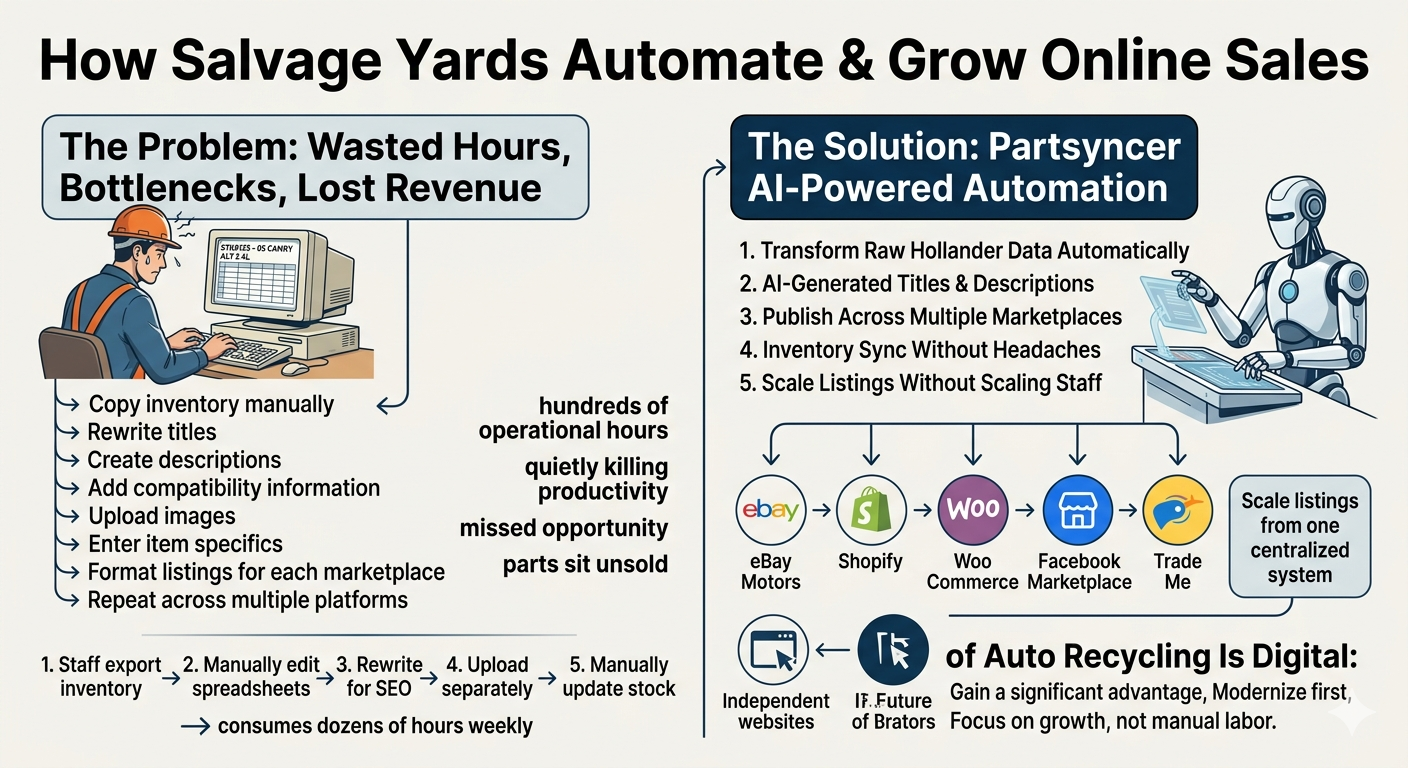
Manual Listing Workflows Are Quietly Killing Productivity

Most salvage yards underestimate how much time disappears into repetitive listing management until they analyze the workflow.

A common process usually looks like this:

Traditional Workflow Problem Created
Export inventory from Pinnacle/Hollander Raw messy data
Edit spreadsheets manually Time-consuming
Rewrite titles for eBay SEO Inconsistent quality
Create descriptions manually Repetitive labor
Upload to multiple marketplaces Duplicate work
Update sold inventory manually Overselling risk

This workflow consumes:

And despite all that manual work, listings are often still:


The Real Cost Isn’t Labor — It’s Lost Revenue

The biggest issue with manual listing operations is not just labor costs.

It’s the missed sales opportunity.

When inventory takes too long to reach marketplaces:

Most salvage yards already own valuable inventory.

But that inventory never reaches its full online selling potential because the operational workflow is too slow.

This creates a hidden scaling ceiling.


Why Multi-Channel Selling Makes The Problem Worse

Modern auto parts businesses cannot rely on a single marketplace anymore.

Successful recyclers now sell across:

But every additional sales channel creates:

Without automation, scaling becomes nearly impossible.


Generic Ecommerce Tools Don’t Understand Salvage Yard Complexity

Most generic ecommerce software was never built for:

Traditional ecommerce platforms fail because they don’t understand:

The automotive recycling industry requires specialized automation infrastructure.


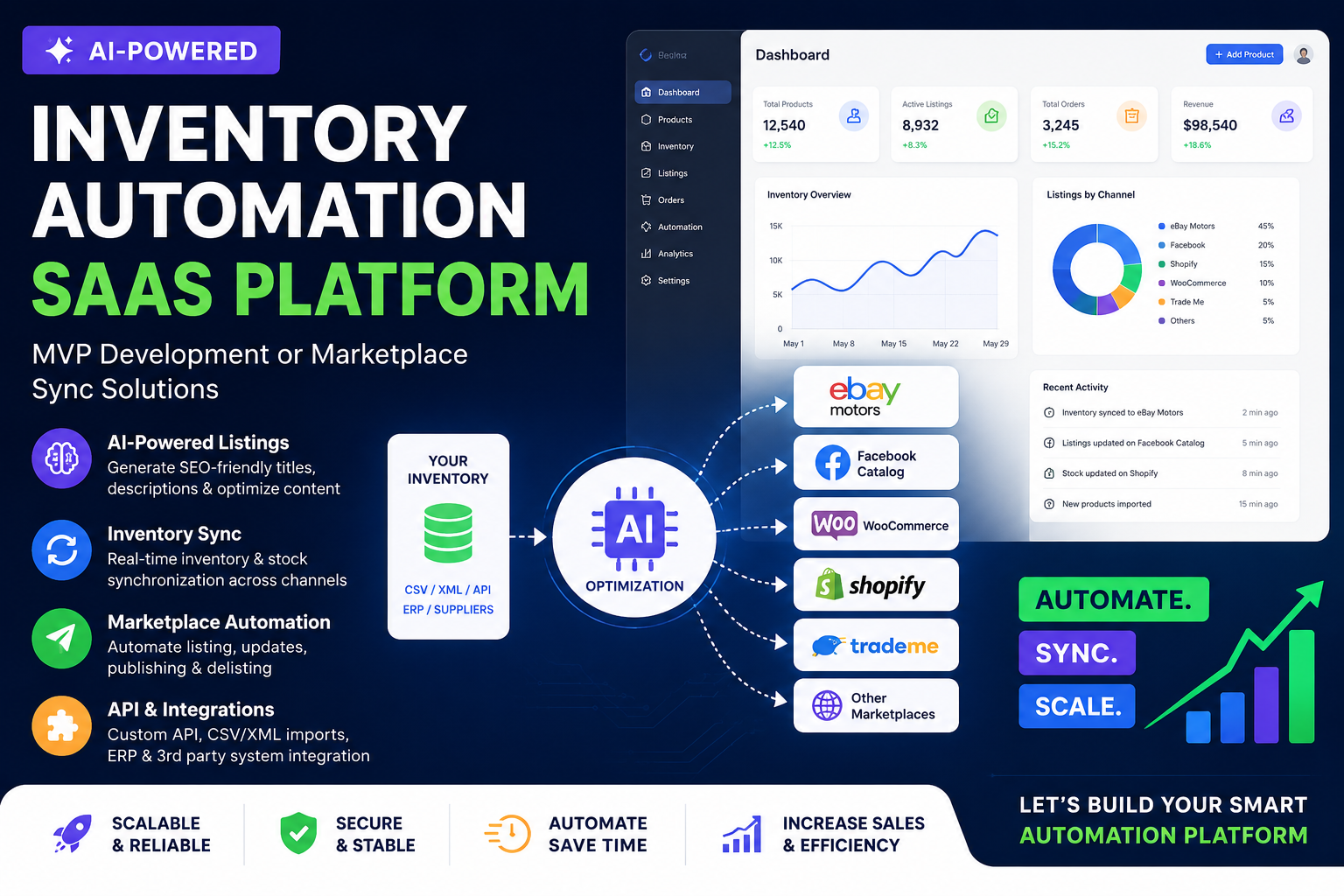
Introducing Partsyncer — AI-Powered Inventory Automation for Auto Recyclers

Partsyncer is designed specifically for:

Instead of manually transforming inventory into listings, Partsyncer automates the complete workflow.


How Partsyncer Automates Auto Parts Listing Operations

1. Import Raw Inventory Automatically

Partsyncer connects directly to:

The system automatically processes raw inventory data into structured marketplace-ready product information.


2. AI-Powered Product Enrichment

Raw salvage inventory is often unreadable for buyers.

Partsyncer uses AI models including:

to automatically:

Example transformation:

Raw Yard Title AI Optimized Listing
ALT ASSY 2AZFE 2008 Toyota Camry Alternator 2.4L OEM Tested Genuine Part

3. Multi-Channel Marketplace Publishing

Instead of manually uploading inventory everywhere, Partsyncer publishes listings across:

from one centralized dashboard.


4. Real-Time Inventory Synchronization

When a part sells on one platform:

This creates a centralized inventory ecosystem.


5. Two-Way API Sync & Dropshipping Workflows

Partsyncer also supports:

The platform becomes a complete automotive inventory middleware system.


Scale Listings Without Scaling Staff

This is where automation becomes transformative.

Instead of hiring additional employees to manage repetitive listing tasks, salvage yards can automate:

Teams can then focus on:


The Future of Automotive Recycling Is AI-Powered

The automotive recycling industry is rapidly moving toward:

Salvage yards still relying on spreadsheets and manual uploads will increasingly struggle to compete against businesses using modern automation systems.

The recyclers who modernize first will gain the largest operational advantage.


Why Work With Me?

I specialize in building automotive inventory automation systems for:

With 10+ years of development experience and large-scale API integration expertise, I help businesses:


Frequently Asked Questions (FAQ)

Q: Can Partsyncer connect with Pinnacle Professional?
Yes. It supports Pinnacle exports, APIs, SQL workflows, and custom inventory integrations.

Q: Does the system support Hollander interchange data?
Yes. Hollander inventory feeds and interchange workflows can be processed and normalized automatically.

Q: Can inventory sync across multiple marketplaces?
Yes. Inventory synchronization supports eBay, WooCommerce, Shopify, Trade Me, Allegro, and custom websites.

Q: Does AI automatically rewrite titles and descriptions?
Yes. AI models can generate SEO-friendly marketplace-ready listing content automatically.

Q: Can sold inventory update automatically?
Yes. Real-time synchronization helps prevent overselling across connected channels.


Ready to Modernize Your Salvage Yard Operations?

Your inventory already has value.

The real challenge is getting that inventory online efficiently, accurately, and at scale.

Automation transforms that process.

📩 Contact me on Upwork to discuss your inventory automation project.

🎯 Order on Fiverr for custom API integrations, marketplace sync systems, and AI-powered automotive inventory automation.

Allegro.pl Automations for Auto Parts Dealers & Dismantlers: AI-Powered Inventory & Marketplace Sync Guide (2026)

In 2026, selling used and new OEM auto parts on Allegro.pl—Poland’s largest ecommerce marketplace—requires more than just competitive pricing. Successful auto parts dealers, dismantlers, recyclers, and salvage yards operate through AI-powered Allegro automation systems that synchronize supplier databases, product data, stock levels, pricing, Polish-language listings, and after-sales workflows in real time.

Whether you sell used OEM parts, aftermarket components, recycled auto parts, or new old stock (NOS) for brands like BMW, Mercedes-Benz, Audi, Volkswagen, Porsche, Ferrari, Tesla, Ford, Opel, Renault, or Toyota, managing thousands of unique SKUs—each with different wear levels, compatibility data, and condition grades—manually across Allegro.pl is impossible at scale.

This is where Allegro API automation, marketplace synchronization software, and AI-driven ecommerce middleware completely transform operations for automotive parts dismantlers, recyclers, salvage operators, and multi-channel sellers across Europe.


The Hidden Cost of Manual Allegro Listing Management for Auto Parts

Many automotive parts sellers, dismantlers, and recyclers still rely on spreadsheets, CSV uploads, virtual assistants, and repetitive copy-paste workflows to manage Allegro listings.

While this may work for dozens of products, it creates serious operational problems when scaling to thousands of used and recycled parts:

For auto parts dealers and dismantlers managing thousands of parts across multiple vehicle brands and generations, these problems scale exponentially.


What Is Allegro.pl Automation for Auto Parts Sellers?

Allegro.pl automation for auto parts dealers, dismantlers, and recyclers combines:

Instead of manually updating each Allegro listing, an automated system handles the entire sales cycle:

The result is a centralized AI-driven Allegro selling engine that manages your entire used and recycled auto parts operation from dismantling bay to after-sales support.


How Marketplace Synchronization Software Works for Allegro.pl

A marketplace synchronization platform for Allegro.pl acts as a central inventory hub between your dismantling operation, suppliers, and the Allegro marketplace.

Product data can be imported from:

For comprehensive inventory synchronization and parts data management, many sellers leverage partsyncer.com to streamline the connection between dismantler software and ecommerce marketplaces like Allegro.

The automation system then:

  1. Fetches raw dismantler/supplier inventory data
  2. Normalizes inconsistent SKU/OEM/brand/model/condition/grade fields
  3. Uses AI to rewrite titles and descriptions in Polish
  4. Maps Allegro categories and required parameters
  5. Optimizes SEO metadata for Allegro search
  6. Publishes listings automatically in bulk
  7. Synchronizes stock in real time after each sale
  8. Processes orders and generates shipment instructions
  9. Handles returns, complaints, and disputes
  10. Updates pricing based on market conditions or aging inventory

Instead of managing multiple disconnected systems, your business gains a single source of truth for all Allegro operations.


AI Product Enrichment: The Biggest Competitive Advantage on Allegro.pl

Most dismantler exports and supplier feeds contain raw, poorly formatted product data—often in English, German, or with internal codes only.

AI enrichment transforms that data into marketplace-ready Polish Allegro listings that convert.

AI-Generated Polish Titles

Convert raw supplier data into high-converting Allegro titles optimized for Polish search queries. Example: “OEM 12345678 – Alternator BMW Seria 3 E90 2.0d oryginał – sprawdzony”

SEO-Friendly Polish Descriptions

Automatically rewrite descriptions using AI models like:

Automatic Allegro Category Mapping

Map supplier part categories (e.g., “Engine Electrical”, “Alternators”) into Allegro’s specific category tree with required parameters (e.g., “Części elektryczne – Alternatory i generatory”).

Condition Grading Automation

Automatically translate used part condition codes (“A-grade”, “Tested working”, “Mint”, “Core”, “For rebuild”) into compliant Polish Allegro condition descriptions.

Image SEO Optimization for Allegro

Generate:

Allegro Compliance Automation

Ensure listings follow Allegro’s platform-specific requirements for:


Used & Recycled Auto Parts Inventory Automation for Allegro (Specialized Workflows)

Selling used, recycled, and remanufactured auto parts on Allegro introduces unique complexity that automation solves.

Key challenges automated:

The automation system integrates with industry-standard dismantler software:

For seamless connectivity between your dismantler software and Allegro.pl, partsyncer.com provides specialized middleware that handles parts data normalization, fitment mapping, and multi-channel inventory sync.

The platform automatically:


Supported Dismantler & Inventory Systems

The automation platform connects with virtually any inventory source. For comprehensive parts data synchronization, many sellers rely on partsyncer.com as their central integration hub.

Dismantler & Salvage Software

Ecommerce Platforms (for direct sales)

Marketplaces (multi-channel expansion)


Real-Time Inventory Synchronization for Allegro.pl

The most critical feature of auto parts automation is real-time synchronization.

When a used part sells on Allegro:

Tools like partsyncer.com excel at maintaining this real-time synchronization across multiple marketplaces and inventory sources simultaneously.

This creates a fully synchronized ecommerce ecosystem between your dismantling operation, suppliers, and Allegro.pl.


Pre-Sales Automation: VIN & OEM Compatibility on Allegro

Auto parts buyers on Allegro constantly ask: “Will this part fit my car?” Answering these questions manually kills profit margins.

Automate compatibility responses with:

Buyer questions that once took 5–15 minutes each are answered in seconds, improving conversion rates, customer satisfaction, and Allegro quality metrics.


Order & Post-Sales Automation for Allegro

After a sale, the automation system handles:


Financial Automation for Auto Parts Sellers on Allegro

Profit margins in used auto parts are tight. Manual financial reconciliation leaves money on the table.

Automated financial workflows include:


Sample Workflow: AI-Powered Allegro Listing Automation for Dismantlers

1. Export inventory from dismantler software (Pinnacle/Hollander/CSV)
2. Import into automation platform via API or file upload
3. AI normalizes OEM numbers, brand, model, condition
4. AI generates Polish title and description
5. System maps to correct Allegro category
6. Fitment data (Year/Make/Model) is structured for Allegro item specifics
7. Images are optimized (resized, ALT tags, watermarks if needed)
8. Listing published to Allegro automatically
9. Inventory monitored for changes
10. Real-time stock sync after each sale
11. Order flows back to dismantler system for picking
12. Tracking pushed to Allegro automatically
13. Returns and complaints handled via automation rules
14. Monthly P&L generated per parts category

Sample API Automation Code (PHP) for Auto Parts Listing

function sync_part_to_allegro($part_data) {

    // Step 1: Normalize dismantler data
    $normalized = normalize_oem_data($part_data);

    // Step 2: AI Enrichment (Polish)
    $optimized = ai_generate_allegro_listing($normalized);

    // Step 3: Check fitment compatibility
    $fitment = map_year_make_model($part_data['compatibility']);

    // Step 4: Build Allegro API payload
    $allegro_payload = [
        'title'         => $optimized['title_pl'],
        'description'   => $optimized['description_pl'],
        'price'         => $part_data['price_pln'],
        'stock'         => $part_data['quantity'],
        'category_id'   => map_allegro_category($part_data['part_type']),
        'parameters'    => $fitment,
        'condition'     => map_used_condition($part_data['grade'])
    ];

    // Step 5: Publish to Allegro
    $result = allegro_api_post('/sale/offer', $allegro_payload);

    // Step 6: Log for inventory sync
    update_inventory_tracker($part_data['sku'], $result['offer_id']);

    return $result;
}

Why Auto Parts Dealers & Dismantlers Are Moving to AI Automation

The automotive parts ecommerce industry is shifting away from disconnected manual systems toward centralized automation platforms.

Businesses want:

AI-driven middleware, including solutions like partsyncer.com, is becoming the backbone of modern auto parts ecommerce operations across Europe and worldwide.


Why Work With a Specialist?

Building custom AI-powered inventory automation systems for auto parts sellers, dismantlers, recyclers, and multi-channel marketplace operations requires deep expertise in both automotive data structures and marketplace APIs.

With 10+ years of experience and 1000+ API integrations delivered, specialist expertise includes:

Working with a specialist helps businesses move from manual operations to scalable automated ecosystems—often with 3-6 month ROI.


Frequently Asked Questions (FAQ)

Q: Can inventory sync in real time from my dismantler software to Allegro?
Yes. Inventory quantities can update instantly using webhooks, scheduled syncs, or real-time API calls from Pinnacle, Hollander, GreenSpark, Car-Part, or custom databases. Solutions like partsyncer.com specialize in this connectivity.

Q: Can AI rewrite product titles and descriptions in Polish automatically?
Yes. AI models like ChatGPT-4, Claude, and Gemini generate SEO-optimized Polish marketplace content that converts better than manual translations.

Q: Can this work with multiple yards or suppliers?
Yes. Multi-source inventory consolidation is fully supported—combine feeds from multiple dismantlers, recyclers, or wholesale suppliers into one Allegro store.

Q: Can automotive fitment data (Year/Make/Model) be managed automatically?
Yes. Advanced systems process vehicle compatibility using VIN decoding, OEM interchange databases, and structured fitment mapping to Allegro item specifics.

Q: How long does implementation take?
Typical implementation for a dismantler with 5,000–20,000 parts is 4–8 weeks, including API integration, AI model training for your part types, and workflow setup.

Q: What if I don’t have a dismantler system—just Excel?
No problem. The automation works with CSV/Excel exports, Google Sheets, or even manual entry portals for smaller yards.

Q: Can it handle core charges and exchange parts?
Yes. Advanced workflows manage core deposits, return label generation for cores, and partial refunds upon core receipt.

Q: What about Allegro Smart! delivery requirements?
The system can enforce Smart! eligibility rules, generate Smart!-compliant shipment labels, and track delivery times to maintain Smart! benefits.

Q: Does this work for new auto parts too?
Absolutely. The same platform handles new OEM, aftermarket, performance, and NOS (new old stock) parts equally well.

Q: Can I sell on Allegro and eBay Motors simultaneously?
Yes. Multi-marketplace sync is a core feature—list once, publish everywhere, sync stock across all channels. Platforms like partsyncer.com are designed for exactly this use case.


Ready to Automate Your Auto Parts Ecommerce Operations?

If you want to eliminate manual listing work, synchronize inventory automatically, reduce returns from fitment errors, and scale across Allegro and other marketplaces, AI-powered automation is the future.

📩 Contact me on Upwork to discuss your project.

🎯 Order on Fiverr for custom automation and marketplace integration services.

🔗 Partner Resource: For specialized parts data synchronization and multi-marketplace inventory management, visit partsyncer.com.


Keywords: Allegro.pl automation, auto parts allegro, dismantler software integration, partsyncer, used auto parts marketplace sync, AI product enrichment Polish, automotive ecommerce automation, salvage yard inventory sync, allegro api integration, multi-channel auto parts selling, used car parts automation, recycler inventory management, allegro fitment data, VIN decoding automation, OEM parts listing automation, polish marketplace automation, auto dismantler ecommerce, car parts allegro seller, allegro super sprzedawca automation, used parts inventory sync, hollander interchange allegro, pinnacle professional integration, greenspark marketplace sync, car-part pro allegro, allegro smart automation, core charge management allegro, cross-border auto parts selling europe.

AI-Powered Inventory Automation & Marketplace Sync Software for Ecommerce Sellers (2026 Guide)

In 2026, successful ecommerce businesses are no longer managing inventory manually across disconnected platforms. Modern sellers operate through AI-powered inventory automation systems that synchronize products, stock levels, pricing, descriptions, and marketplace listings in real time.

Whether you sell automotive parts, electronics, fashion products, industrial equipment, recycled components, or large supplier catalogs, managing listings manually across platforms like WooCommerce, Shopify, eBay Motors, Amazon, Trade Me, Facebook Marketplace, Etsy, Walmart, and custom websites quickly becomes unmanageable.

This is where AI inventory automation software, marketplace synchronization systems, and API-driven ecommerce middleware completely transform operations.


The Hidden Cost of Manual Inventory Management

Many businesses still rely on spreadsheets, CSV uploads, virtual assistants, and repetitive listing workflows.

While this may work temporarily, it creates serious long-term operational problems:

For automotive parts sellers, dismantlers, recyclers, and inventory-heavy ecommerce businesses, these problems scale exponentially.


What Is AI-Powered Inventory Automation?

AI inventory automation combines:

Instead of manually updating listings, businesses can automate:

The result is a centralized AI-driven ecommerce engine that manages operations across every connected sales channel.


How Marketplace Synchronization Software Works

A marketplace synchronization platform acts as a central inventory hub.

Products can be imported from:

The system then:

  1. Fetches raw inventory data
  2. Normalizes inconsistent product structures
  3. Uses AI to rewrite titles and descriptions
  4. Maps categories and attributes
  5. Optimizes SEO metadata
  6. Publishes listings automatically
  7. Synchronizes stock in real time
  8. Processes orders and inventory updates

Instead of managing multiple disconnected systems, businesses gain a single source of truth.


AI Product Enrichment: The Biggest Competitive Advantage

Most supplier feeds and ERP exports contain raw, poorly formatted product data.

AI enrichment transforms that data into marketplace-ready listings.

AI-Generated Titles

Convert raw supplier data into high-converting product titles optimized for marketplace search visibility.

SEO-Friendly Descriptions

Automatically rewrite descriptions using AI models like:

Automatic Category Mapping

Map supplier categories into marketplace-specific taxonomy structures.

Image SEO Optimization

Generate:

Marketplace Compliance

Ensure listings follow platform-specific requirements for attributes, fitment, conditions, and item specifics.


Automotive Parts Inventory Automation (Specialized Workflows)

Automotive ecommerce introduces additional complexity.

Businesses managing auto parts often deal with:

Modern automation systems can integrate with:

The platform can automatically:


Supported Ecommerce Platforms & Marketplaces

Ecommerce Platforms

Marketplaces


Real-Time Inventory Synchronization

The most critical feature of enterprise-grade automation is real-time synchronization.

When a product sells:

This creates a fully synchronized ecommerce ecosystem.


Enterprise Architecture & Scalability

Large catalogs require enterprise-level processing architecture.

Modern systems use:

This allows businesses to safely manage:


Sample Workflow: AI Marketplace Listing Automation

1. Import inventory from ERP/API/XML/CSV
2. Normalize product structure
3. AI rewrites titles and descriptions
4. Generate SEO metadata
5. Map marketplace categories
6. Sync fitment and attributes
7. Publish listings automatically
8. Monitor inventory changes
9. Push stock updates in real time
10. Sync orders back to supplier or ERP

Sample API Automation Code (PHP)

function sync_product_to_marketplaces($product) {

    // AI Enrichment
    $optimized = ai_rewrite_product($product);

    // Marketplace Payload
    $payload = [
        'title'       => $optimized['title'],
        'description' => $optimized['description'],
        'price'       => $product['price'],
        'quantity'    => $product['stock']
    ];

    // Push to marketplaces
    push_to_ebay($payload);
    push_to_shopify($payload);
    push_to_woocommerce($payload);

    return true;
}

Why Businesses Are Moving Toward AI SaaS Platforms

The ecommerce industry is shifting away from disconnected manual systems toward centralized automation platforms.

Businesses want:

AI-driven middleware is becoming the backbone of modern ecommerce operations.


Why Work With Me?

I build custom AI-powered inventory automation systems for ecommerce businesses, automotive parts sellers, dismantlers, suppliers, and multi-channel marketplace operations.

With 10+ years of experience and 1000+ API integrations delivered, I specialize in:

I help businesses move from manual operations to scalable automated ecosystems.


Frequently Asked Questions (FAQ)

Q: Can inventory sync in real time across marketplaces?
Yes. Inventory quantities can update instantly using APIs, webhooks, and automation workflows.

Q: Can AI rewrite product titles and descriptions automatically?
Yes. AI models like ChatGPT, Claude, and Gemini can generate SEO-optimized marketplace content.

Q: Can this work with WooCommerce and Shopify together?
Yes. Multi-platform synchronization is fully supported.

Q: Can automotive fitment data be managed automatically?
Yes. Advanced systems can process Year/Make/Model compatibility and interchange data.


Ready to Automate Your Ecommerce Operations?

If you want to eliminate manual listing work, synchronize inventory automatically, and scale across marketplaces, AI-powered automation is the future.

📩 Contact me on Upwork to discuss your project.

🎯 Order on Fiverr for custom automation and marketplace integration services.

Automotive Data Integration Guide (2026): Global Inventory Sources & Marketplaces for Auto Parts Selling

In 2026, the automotive parts industry is no longer limited by geography. Whether you operate in the USA, UK, Europe, Australia, or the Middle East, success depends on one thing: how efficiently you connect your inventory sources with global selling platforms.

Auto recyclers, dismantlers, and parts sellers are moving toward fully automated, API-driven ecosystems that allow them to pull inventory from systems like Pinnacle and Hollander and distribute it worldwide across marketplaces and eCommerce stores.

This guide covers all major automotive data sources and global selling platforms—helping you understand how to build a scalable, international parts business.


Understanding the Global Automotive Data Ecosystem

The system works in two layers:

A modern integration connects both layers using middleware and APIs, enabling real-time, global distribution.


Global Auto Parts Inventory Sources (Data Providers)

These are the systems used worldwide by recyclers, dismantlers, suppliers, and OEM networks:

Enterprise Yard Management Systems

Modern Cloud-Based Platforms

OEM & Aftermarket Data Providers

Custom & Internal Data Sources

Each source uses different formats, requiring data normalization and mapping before distribution.


Global Auto Parts Marketplaces & Sales Channels

Once your data is structured, it can be distributed globally across multiple high-traffic platforms:

Global Marketplaces

Regional Marketplaces (Worldwide)

eCommerce Platforms

Custom Platforms

This allows businesses to reach buyers across multiple countries simultaneously.


The Biggest Problem: Fragmented Systems

Without integration, businesses face:

This creates operational bottlenecks and limits growth.


The Solution: Global API-Driven Middleware

A centralized system connects everything:

This turns your business into a global, automated distribution engine.


AI-Powered Optimization for Global Reach

To compete internationally, listings must be optimized:

This improves visibility across search engines and marketplace algorithms.


Technical Workflow (Global Architecture)

  1. Extract Data – From ERP, CRM, API, or feeds
  2. Normalize – Standardize all inventory data
  3. Enrich – AI optimization for SEO and readability
  4. Map – Align categories and attributes per platform
  5. Distribute – Push listings globally
  6. Sync – Real-time inventory and order updates

Who Needs This System?


Why This Matters for Growth


Why Work With Me?

I specialize in building global automotive API integrations that connect inventory sources with marketplaces worldwide.

With 1000+ integrations delivered, I design systems that are scalable, automated, and built for international growth.


Frequently Asked Questions (FAQ)

Q: Can I sell globally using one system?
Yes. Middleware allows you to distribute inventory across multiple countries and platforms.

Q: Do I need API access for all systems?
Not always. XML, CSV, and database exports can also be integrated.

Q: Can this work with Shopify and WooCommerce?
Yes. Both platforms support full API-based automation.

Q: How do I manage stock globally?
Through real-time synchronization across all connected platforms.


Ready to Scale Your Auto Parts Business Globally?

If you want to connect your inventory with global marketplaces and automate your operations, a centralized integration system is essential.

📩 Contact me on Upwork

🎯 Order on Fiverr

Shopify Data Import via API, CRM, XML & JSON (Real-Time Sync & Automation Guide 2026)

In 2026, successful eCommerce businesses are no longer managing products manually inside Shopify. Instead, they rely on automated data import systems that sync products, inventory, pricing, and orders directly from CRMs, ERPs, APIs, and external feeds.

If you’re dealing with large catalogs, multiple suppliers, or external systems, a Shopify API integration becomes essential to eliminate manual work and ensure real-time accuracy.


What Shopify Data Import Really Means in 2026

Modern Shopify stores are powered by data pipelines, not spreadsheets.

This is not just “importing”—this is full system integration.


Supported Data Sources for Shopify Integration

CRM & ERP Systems

Feed Formats & APIs

Supplier & Marketplace Data


Common Problems with Basic Shopify Imports

To scale, you need automation + API-based sync.


Advanced Shopify API Integration (How It Works)

A professional integration system works as a middleware layer between Shopify and your external systems.

  1. Data Fetching – Pull products from API, XML, or CRM
  2. Normalization – Map fields (title, price, SKU, inventory)
  3. Data Enrichment – Optimize titles, descriptions, SEO
  4. Batch Processing – Import in chunks to avoid timeouts
  5. Shopify Sync – Create/update products via API
  6. Two-Way Sync – Send orders back to CRM/ERP

Two-Way Sync: Orders Back to CRM/ERP

Integration is not complete without sending data back.

This ensures real-time business operations.


AI-Powered Product Data Enrichment

Raw supplier data is often unoptimized. With AI, you can:

This increases visibility, conversions, and search rankings.


Sample Code: Shopify Product Import via API (PHP)

function shopify_create_product($product) {

    $shop = "your-store.myshopify.com";
    $access_token = "your-access-token";

    $payload = [
        "product" => [
            "title" => $product['title'],
            "body_html" => $product['description'],
            "vendor" => $product['brand'],
            "variants" => [
                [
                    "price" => $product['price'],
                    "sku" => $product['sku']
                ]
            ]
        ]
    ];

    $ch = curl_init("https://$shop/admin/api/2024-01/products.json");

    curl_setopt($ch, CURLOPT_HTTPHEADER, [
        "Content-Type: application/json",
        "X-Shopify-Access-Token: $access_token"
    ]);

    curl_setopt($ch, CURLOPT_POST, true);
    curl_setopt($ch, CURLOPT_POSTFIELDS, json_encode($payload));
    curl_setopt($ch, CURLOPT_RETURNTRANSFER, true);

    $response = curl_exec($ch);
    curl_close($ch);

    return $response;
}

Core Features of Shopify Data Integration


Why This Matters for eCommerce Growth


Why Work With Me?

I specialize in Shopify API integrations and data automation systems. With 10+ years of experience and 1000+ integrations delivered, I build scalable solutions that connect your entire business ecosystem.


Frequently Asked Questions

Q: Can Shopify import products from API?
Yes, Shopify supports API-based product creation and updates via REST or GraphQL.

Q: Can I sync Shopify with my CRM?
Yes, using custom API integration or middleware.

Q: Does Shopify support real-time inventory sync?
Yes, using webhooks and API updates.

Q: Can I automate product updates?
Yes, using cron jobs or event-driven workflows.


Ready to Automate Your Shopify Store?

Stop managing data manually. Build a fully automated Shopify integration system that scales with your business.

📩 Contact me on Upwork

🎯 Order on Fiverr