
AI-Powered Inventory Automation & Marketplace Sync Software for Ecommerce Sellers (2026 Guide)
AI-Powered Inventory Automation & Marketplace Sync Software for Ecommerce Sellers (2026 Guide)
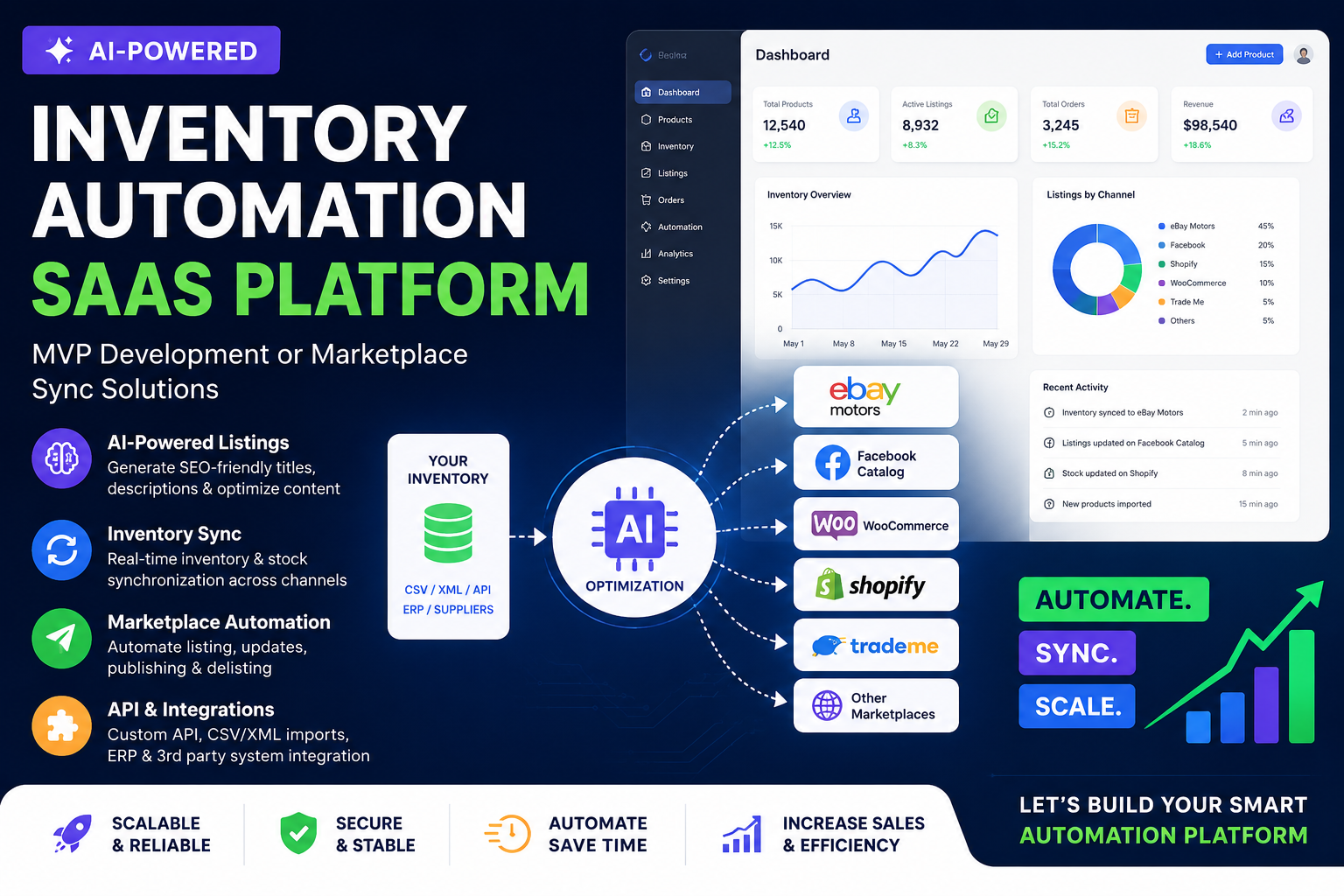
In 2026, successful ecommerce businesses are no longer managing inventory manually across disconnected platforms. Modern sellers operate through AI-powered inventory automation systems that synchronize products, stock levels, pricing, descriptions, and marketplace listings in real time.
Whether you sell automotive parts, electronics, fashion products, industrial equipment, recycled components, or large supplier catalogs, managing listings manually across platforms like WooCommerce, Shopify, eBay Motors, Amazon, Trade Me, Facebook Marketplace, Etsy, Walmart, and custom websites quickly becomes unmanageable.
This is where AI inventory automation software, marketplace synchronization systems, and API-driven ecommerce middleware completely transform operations.
The Hidden Cost of Manual Inventory Management
Many businesses still rely on spreadsheets, CSV uploads, virtual assistants, and repetitive listing workflows.
While this may work temporarily, it creates serious long-term operational problems:
- Outdated inventory quantities
- Overselling products across marketplaces
- Inconsistent product data
- Slow listing creation workflows
- Poor SEO optimization
- Duplicate manual labor
- Marketplace synchronization failures
- Incorrect product categorization
- Human errors in pricing and stock
For automotive parts sellers, dismantlers, recyclers, and inventory-heavy ecommerce businesses, these problems scale exponentially.
What Is AI-Powered Inventory Automation?
AI inventory automation combines:
- Artificial intelligence
- Marketplace APIs
- Workflow automation
- Inventory synchronization
- Bulk product enrichment
- Real-time stock management
Instead of manually updating listings, businesses can automate:
- Product title generation
- SEO-friendly descriptions
- Category mapping
- Marketplace publishing
- Price synchronization
- Inventory quantity updates
- Product image optimization
- Fitment data management
- Shipping rules and logistics
The result is a centralized AI-driven ecommerce engine that manages operations across every connected sales channel.
How Marketplace Synchronization Software Works
A marketplace synchronization platform acts as a central inventory hub.
Products can be imported from:
- ERP systems
- Supplier APIs
- CSV feeds
- XML feeds
- JSON APIs
- Google Sheets
- WooCommerce stores
- Shopify stores
- PIM systems
- Warehouse databases
- Automotive DMS systems
- Custom SaaS platforms
The system then:
- Fetches raw inventory data
- Normalizes inconsistent product structures
- Uses AI to rewrite titles and descriptions
- Maps categories and attributes
- Optimizes SEO metadata
- Publishes listings automatically
- Synchronizes stock in real time
- Processes orders and inventory updates
Instead of managing multiple disconnected systems, businesses gain a single source of truth.
AI Product Enrichment: The Biggest Competitive Advantage
Most supplier feeds and ERP exports contain raw, poorly formatted product data.
AI enrichment transforms that data into marketplace-ready listings.
AI-Generated Titles
Convert raw supplier data into high-converting product titles optimized for marketplace search visibility.
SEO-Friendly Descriptions
Automatically rewrite descriptions using AI models like:
- ChatGPT
- Claude
- Gemini
- Custom LLM workflows
Automatic Category Mapping
Map supplier categories into marketplace-specific taxonomy structures.
Image SEO Optimization
Generate:
- ALT tags
- captions
- structured metadata
- image filenames
Marketplace Compliance
Ensure listings follow platform-specific requirements for attributes, fitment, conditions, and item specifics.
Automotive Parts Inventory Automation (Specialized Workflows)
Automotive ecommerce introduces additional complexity.
Businesses managing auto parts often deal with:
- Vehicle compatibility data
- Fitment mapping
- Interchange systems
- Large dismantler inventories
- Supplier feeds
- Used parts databases
- Multi-channel marketplaces
Modern automation systems can integrate with:
- Pinnacle Professional
- Hollander
- Solera systems
- GreenSpark
- PartsTech
- Custom dismantler software
The platform can automatically:
- Generate SEO listings
- Map Year/Make/Model fitment
- Push inventory to marketplaces
- Sync sold inventory instantly
- Update quantities across all channels
- Handle order callbacks and dropshipping workflows
Supported Ecommerce Platforms & Marketplaces
Ecommerce Platforms
- WooCommerce
- Shopify
- Magento
- BigCommerce
- OpenCart
- PrestaShop
- Custom Laravel applications
- Headless ecommerce systems
Marketplaces
- eBay Motors
- Amazon
- Trade Me Motors
- Facebook Marketplace
- Walmart Marketplace
- Etsy
- Ricardo.ch
- Rakuten
- Mercado Libre
Real-Time Inventory Synchronization
The most critical feature of enterprise-grade automation is real-time synchronization.
When a product sells:
- Inventory quantities update instantly
- Other marketplaces reflect stock changes
- Overselling is prevented
- Orders can sync back to suppliers or ERP systems
- Pricing adjustments propagate automatically
This creates a fully synchronized ecommerce ecosystem.
Enterprise Architecture & Scalability
Large catalogs require enterprise-level processing architecture.
Modern systems use:
- Queue workers
- Chunk processing
- Webhook listeners
- Scheduled cron synchronization
- Distributed API handling
- Background job processing
- Cloud-based scaling
This allows businesses to safely manage:
- Hundreds of thousands of SKUs
- Massive image libraries
- Multi-marketplace operations
- High-frequency inventory updates
Sample Workflow: AI Marketplace Listing Automation
1. Import inventory from ERP/API/XML/CSV
2. Normalize product structure
3. AI rewrites titles and descriptions
4. Generate SEO metadata
5. Map marketplace categories
6. Sync fitment and attributes
7. Publish listings automatically
8. Monitor inventory changes
9. Push stock updates in real time
10. Sync orders back to supplier or ERP
Sample API Automation Code (PHP)
function sync_product_to_marketplaces($product) {

    // AI Enrichment
    $optimized = ai_rewrite_product($product);

    // Marketplace Payload
    $payload = [
        'title'       => $optimized['title'],
        'description' => $optimized['description'],
        'price'       => $product['price'],
        'quantity'    => $product['stock']
    ];

    // Push to marketplaces
    push_to_ebay($payload);
    push_to_shopify($payload);
    push_to_woocommerce($payload);

    return true;
}
Why Businesses Are Moving Toward AI SaaS Platforms
The ecommerce industry is shifting away from disconnected manual systems toward centralized automation platforms.
Businesses want:
- Centralized inventory management
- AI-powered content generation
- Real-time marketplace synchronization
- Workflow automation
- Scalable infrastructure
- Reduced operational costs
- Faster marketplace expansion
AI-driven middleware is becoming the backbone of modern ecommerce operations.
Why Work With Me?
I build custom AI-powered inventory automation systems for ecommerce businesses, automotive parts sellers, dismantlers, suppliers, and multi-channel marketplace operations.
With 10+ years of experience and 1000+ API integrations delivered, I specialize in:
- Marketplace synchronization systems
- ERP & supplier integrations
- AI product enrichment workflows
- WooCommerce & Shopify automation
- Automotive inventory middleware
- Enterprise SaaS architecture
I help businesses move from manual operations to scalable automated ecosystems.
Frequently Asked Questions (FAQ)
Q: Can inventory sync in real time across marketplaces?
Yes. Inventory quantities can update instantly using APIs, webhooks, and automation workflows.
Q: Can AI rewrite product titles and descriptions automatically?
Yes. AI models like ChatGPT, Claude, and Gemini can generate SEO-optimized marketplace content.
Q: Can this work with WooCommerce and Shopify together?
Yes. Multi-platform synchronization is fully supported.
Q: Can automotive fitment data be managed automatically?
Yes. Advanced systems can process Year/Make/Model compatibility and interchange data.
Ready to Automate Your Ecommerce Operations?
If you want to eliminate manual listing work, synchronize inventory automatically, and scale across marketplaces, AI-powered automation is the future.
📩 Contact me on Upwork to discuss your project.
🎯 Order on Fiverr for custom automation and marketplace integration services.