
How Salvage Yards Are Wasting Hundreds of Hours Manually Listing Auto Parts Online – Partsyncer
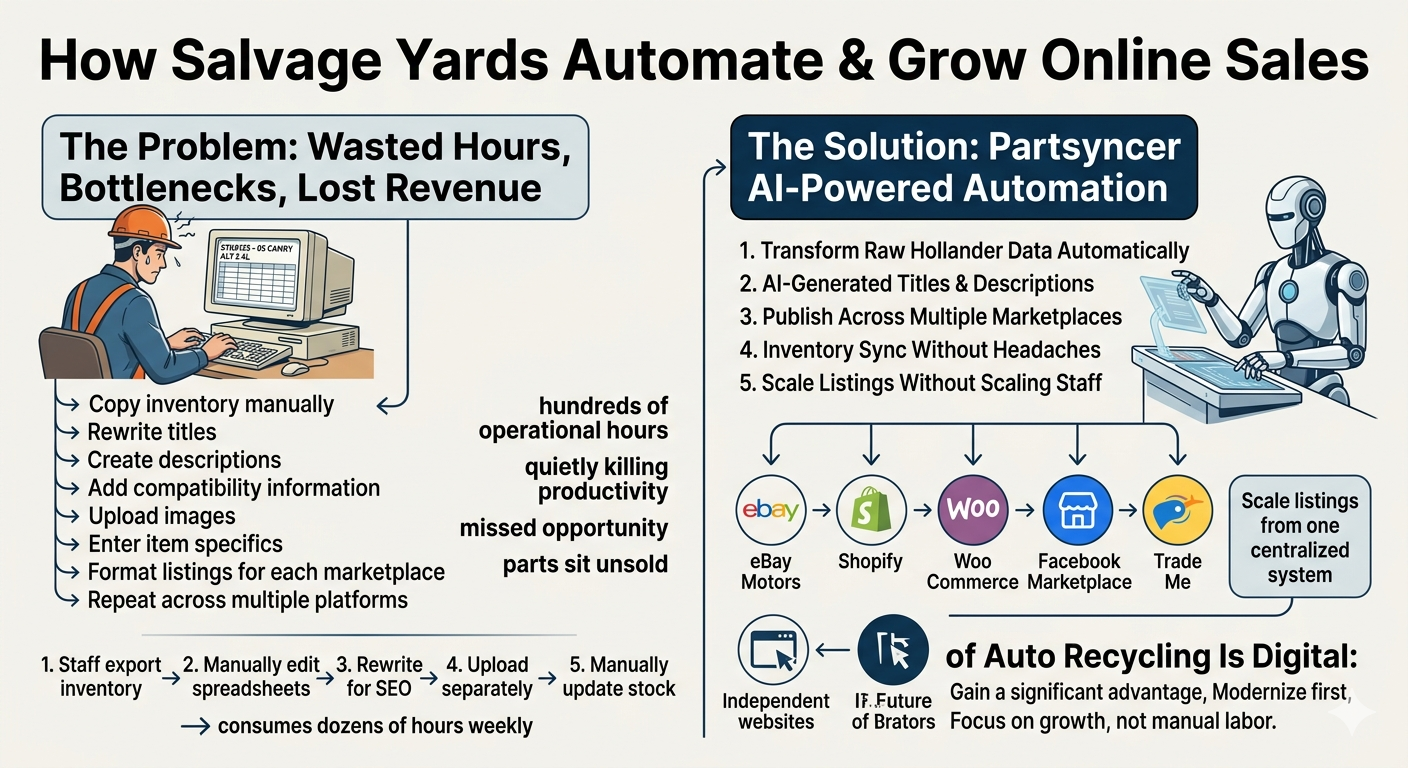
How Salvage Yards Are Wasting Hundreds of Hours Manually Listing Auto Parts Online
In 2026, the automotive recycling industry is rapidly shifting toward AI-powered ecommerce operations, multi-channel marketplace selling, and automated inventory distribution.
Buyers no longer call salvage yards asking if a part is available.
Today’s customers search online across:
- eBay Motors
- WooCommerce stores
- Shopify websites
- Facebook Marketplace
- Trade Me Motors
- Allegro
- Amazon
- Independent auto parts websites
But while online demand has exploded, many salvage yards and auto recyclers are still relying on manual listing workflows that waste hundreds of operational hours every month.
The result?
- Slow inventory publishing
- Poor marketplace visibility
- Inconsistent listings
- Overselling problems
- Lost revenue opportunities
The inventory already exists.
The demand already exists.
The real bottleneck is the workflow.
The Hidden Operational Problem Inside Most Salvage Yards
Systems like Pinnacle Professional, Hollander Interchange, Powerlink, and other dismantler management systems were originally designed for:
- inventory management
- yard operations
- interchange referencing
- vehicle dismantling workflows
They were not designed for modern ecommerce automation.
That creates a massive operational gap.
Raw inventory data exported from these systems often contains:
- messy titles
- abbreviated descriptions
- internal stock codes
- technical interchange references
- unstructured compatibility information
Before a single part can even be listed online, staff members usually need to manually:
- copy inventory data
- rewrite titles
- create descriptions
- add fitment details
- upload images
- configure marketplace specifics
- format data for each platform separately
Now multiply that process by:
- 10,000 parts
- 50,000 parts
- 100,000+ inventory records
The operational inefficiency becomes enormous.
Manual Listing Workflows Are Quietly Killing Productivity
Most salvage yards underestimate how much time disappears into repetitive listing management until they analyze the workflow.
A common process usually looks like this:
| Traditional Workflow | Problem Created |
|---|---|
| Export inventory from Pinnacle/Hollander | Raw messy data |
| Edit spreadsheets manually | Time-consuming |
| Rewrite titles for eBay SEO | Inconsistent quality |
| Create descriptions manually | Repetitive labor |
| Upload to multiple marketplaces | Duplicate work |
| Update sold inventory manually | Overselling risk |
This workflow consumes:
- dozens of employee hours weekly
- multiple staff members
- constant repetitive operational effort
And despite all that manual work, listings are often still:
- poorly optimized
- hard to search
- inconsistent
- missing fitment data
- unprofessional-looking
The Real Cost Isn’t Labor — It’s Lost Revenue
The biggest issue with manual listing operations is not just labor costs.
It’s the missed sales opportunity.
When inventory takes too long to reach marketplaces:
- buyers never discover the parts
- search visibility decreases
- competitors capture the sale first
- inventory sits unsold longer
Most salvage yards already own valuable inventory.
But that inventory never reaches its full online selling potential because the operational workflow is too slow.
This creates a hidden scaling ceiling.
Why Multi-Channel Selling Makes The Problem Worse
Modern auto parts businesses cannot rely on a single marketplace anymore.
Successful recyclers now sell across:
- eBay Motors
- Trade Me Motors
- WooCommerce
- Shopify
- Amazon
- Allegro
- Facebook Marketplace
- Mercado Libre
- Custom ecommerce websites
But every additional sales channel creates:
- inventory fragmentation
- manual synchronization problems
- overselling risk
- inconsistent listings
- operational overhead
Without automation, scaling becomes nearly impossible.
Generic Ecommerce Tools Don’t Understand Salvage Yard Complexity
Most generic ecommerce software was never built for:
- salvage yard operations
- dismantlers
- used OEM parts
- Hollander interchange workflows
- fitment-heavy inventory
- recycled automotive parts
Traditional ecommerce platforms fail because they don’t understand:
- interchange numbers
- vehicle compatibility
- grade conditions
- recycled inventory logic
- yard management workflows
The automotive recycling industry requires specialized automation infrastructure.
Introducing Partsyncer — AI-Powered Inventory Automation for Auto Recyclers
Partsyncer is designed specifically for:
- salvage yards
- wreckers
- dismantlers
- used auto parts suppliers
- Pinnacle users
- Hollander recyclers
- multi-channel automotive sellers
Instead of manually transforming inventory into listings, Partsyncer automates the complete workflow.
How Partsyncer Automates Auto Parts Listing Operations
1. Import Raw Inventory Automatically
Partsyncer connects directly to:
- Pinnacle Professional
- Hollander XML feeds
- CSV exports
- JSON APIs
- SQL databases
- supplier inventory feeds
- custom ERP systems
The system automatically processes raw inventory data into structured marketplace-ready product information.
2. AI-Powered Product Enrichment
Raw salvage inventory is often unreadable for buyers.
Partsyncer uses AI models including:
- ChatGPT
- Claude
- Gemini
to automatically:
- rewrite titles
- generate SEO descriptions
- improve readability
- optimize marketplace keywords
- structure fitment data
- generate item specifics
Example transformation:
| Raw Yard Title | AI Optimized Listing |
|---|---|
| ALT ASSY 2AZFE | 2008 Toyota Camry Alternator 2.4L OEM Tested Genuine Part |
3. Multi-Channel Marketplace Publishing
Instead of manually uploading inventory everywhere, Partsyncer publishes listings across:
- eBay Motors
- Trade Me Motors
- WooCommerce
- Shopify
- Facebook Marketplace
- Allegro
- Custom websites
from one centralized dashboard.
4. Real-Time Inventory Synchronization
When a part sells on one platform:
- inventory updates automatically
- stock quantities synchronize
- duplicate listings deactivate
- overselling risks decrease
This creates a centralized inventory ecosystem.
5. Two-Way API Sync & Dropshipping Workflows
Partsyncer also supports:
- order postback to source systems
- dropshipping workflows
- supplier inventory synchronization
- pricing automation
- shipping rule management
- category mapping
The platform becomes a complete automotive inventory middleware system.
Scale Listings Without Scaling Staff
This is where automation becomes transformative.
Instead of hiring additional employees to manage repetitive listing tasks, salvage yards can automate:
- inventory imports
- title rewriting
- description generation
- marketplace synchronization
- inventory updates
- fitment processing
Teams can then focus on:
- sourcing inventory
- fulfillment
- sales growth
- customer service
- business expansion
The Future of Automotive Recycling Is AI-Powered
The automotive recycling industry is rapidly moving toward:
- AI-powered listing systems
- automated inventory infrastructure
- real-time marketplace synchronization
- centralized ecommerce management
- workflow automation
Salvage yards still relying on spreadsheets and manual uploads will increasingly struggle to compete against businesses using modern automation systems.
The recyclers who modernize first will gain the largest operational advantage.
Why Work With Me?
I specialize in building automotive inventory automation systems for:
- salvage yards
- wreckers
- used auto parts suppliers
- dismantlers
- multi-channel ecommerce businesses
With 10+ years of development experience and large-scale API integration expertise, I help businesses:
- automate inventory operations
- build scalable listing systems
- integrate Pinnacle & Hollander
- sync marketplaces in real time
- improve listing SEO using AI
Frequently Asked Questions (FAQ)
Q: Can Partsyncer connect with Pinnacle Professional?
Yes. It supports Pinnacle exports, APIs, SQL workflows, and custom inventory integrations.
Q: Does the system support Hollander interchange data?
Yes. Hollander inventory feeds and interchange workflows can be processed and normalized automatically.
Q: Can inventory sync across multiple marketplaces?
Yes. Inventory synchronization supports eBay, WooCommerce, Shopify, Trade Me, Allegro, and custom websites.
Q: Does AI automatically rewrite titles and descriptions?
Yes. AI models can generate SEO-friendly marketplace-ready listing content automatically.
Q: Can sold inventory update automatically?
Yes. Real-time synchronization helps prevent overselling across connected channels.
Ready to Modernize Your Salvage Yard Operations?
Your inventory already has value.
The real challenge is getting that inventory online efficiently, accurately, and at scale.
Automation transforms that process.
📩 Contact me on Upwork to discuss your inventory automation project.
🎯 Order on Fiverr for custom API integrations, marketplace sync systems, and AI-powered automotive inventory automation.