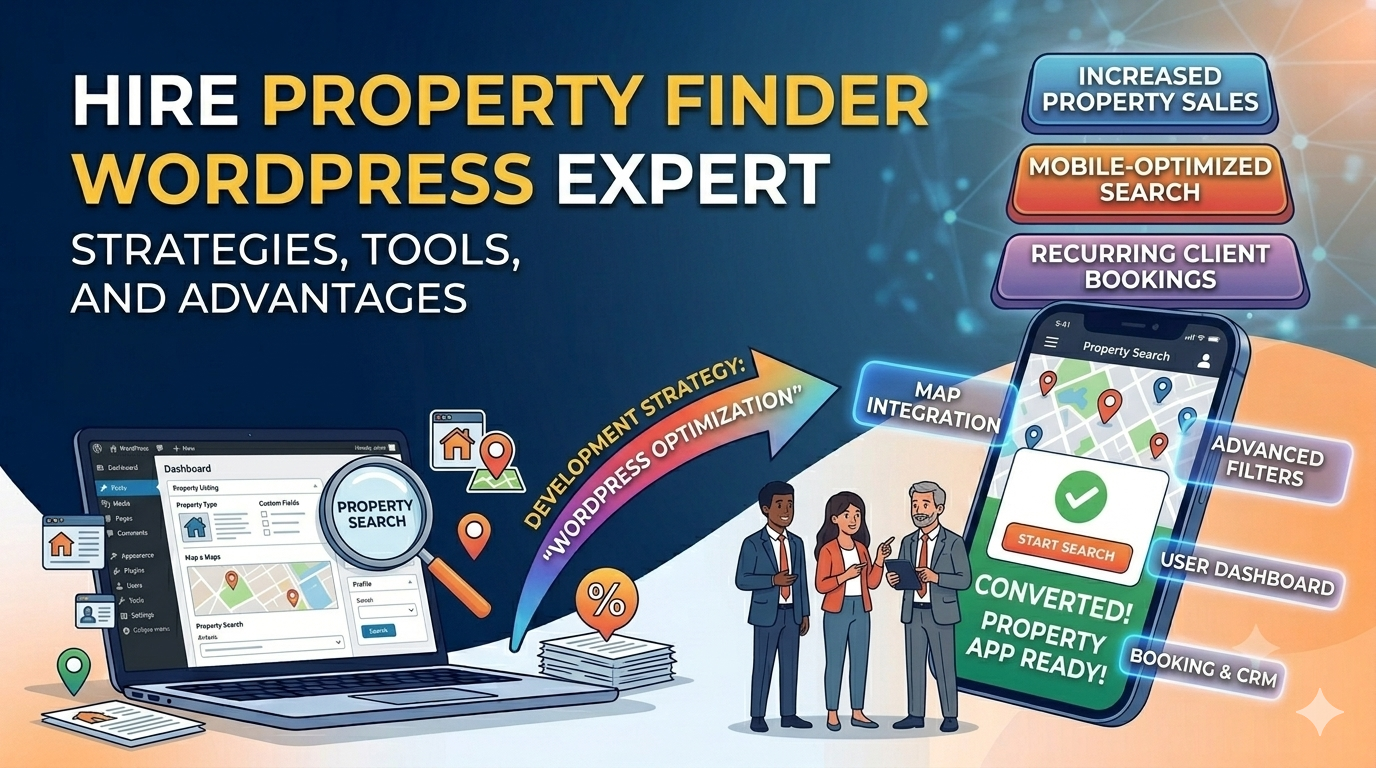
Property Finder WordPress Expert

Property Finder Expert: WordPress, API, XML Feed & CRM Integration Specialist

The real estate industry is becoming increasingly automated, and one platform that continues to dominate the Middle East market is Property Finder.

Whether you are a real estate agency, property developer, brokerage, property portal, CRM provider, or PropTech startup, maintaining accurate property listings across multiple platforms is critical for generating leads and closing deals.

Many agencies struggle with:

  • Manual property uploads
  • Duplicate listing management
  • Outdated property information
  • Missing images and media
  • Property Finder XML feed errors
  • API synchronization challenges
  • SEO limitations on imported listings
  • Multi-portal listing management

This is where a Property Finder Expert becomes valuable.

Instead of manually managing listings, modern real estate businesses are using automated synchronization systems that connect Property Finder with WordPress, Houzez, CRM systems, APIs, XML feeds, and custom real estate platforms.


What Does a Property Finder Expert Do?

A Property Finder integration specialist helps real estate businesses automate the flow of property data between multiple systems.

This includes:

  • Property Finder XML Feed Integration
  • Property Finder API Integration
  • Property Finder CRM Synchronization
  • WordPress Property Imports
  • Houzez Property Feed Automation
  • WP Residence Property Sync
  • Homey Property Import Solutions
  • Custom Real Estate Portal Development
  • Lead Synchronization
  • Property Data Aggregation
  • SEO Optimization for Imported Listings

The objective is simple:

Enter property data once and automatically distribute it everywhere.


Property Finder XML Feed Integration

The most common method of synchronizing listings with Property Finder is through XML feeds.

A Property Finder XML integration can automatically:

  • Create new listings
  • Update existing listings
  • Remove sold properties
  • Sync property images
  • Update prices
  • Manage property status changes
  • Synchronize agent information
  • Update property features and amenities

Instead of uploading spreadsheets manually, the XML feed becomes an automated bridge between your CRM and Property Finder.


Property Finder API Integration

Modern real estate systems increasingly use APIs instead of static XML files.

API integrations provide:

  • Real-time updates
  • Instant listing synchronization
  • Faster data processing
  • Two-way communication
  • Lead synchronization
  • Better scalability
  • Reduced manual work

Property Finder API workflows can synchronize:

  • Properties
  • Agents
  • Leads
  • Images
  • Floor plans
  • Videos
  • Property status updates
  • Availability information

Supported Real Estate CRMs

A Property Finder expert typically works with multiple real estate CRM systems.

  • Property Finder CRM
  • PropSpace CRM
  • MyCRM
  • Zoho CRM
  • Salesforce
  • HubSpot
  • Apimo
  • Reapit
  • Alto (Vebra)
  • Rex Software
  • Agentbox
  • VaultRE
  • MioGest
  • Pixxi
  • eGO Real Estate
  • Propertybase
  • Custom CRM Systems

Multiple CRM sources can be merged into a single centralized property database.


WordPress & Houzez Property Finder Integration

Many agencies use WordPress because of its flexibility and SEO advantages.

Popular integrations include:

  • Houzez Property Finder Integration
  • WP Residence Property Import
  • Homey Property Sync
  • MyHome Integration
  • RealHomes Property Automation
  • Custom WordPress Property Portals

Listings can be imported directly into WordPress and automatically synchronized in real time.

Changes made inside the CRM or Property Finder can instantly appear on the website.


Advanced Multi-Source Property Aggregation

Many agencies work with multiple listing sources simultaneously.

Modern synchronization platforms can aggregate:

  • Property Finder
  • Bayut
  • Dubizzle
  • Rightmove
  • Zoopla
  • Kyero
  • Idealista
  • ImmoScout24
  • MioGest
  • Apimo
  • Custom APIs
  • XML Feeds
  • JSON Feeds
  • Google Sheets
  • MLS Data Sources

The system normalizes all incoming data into a single structure before publishing it to websites and portals.


AI-Powered Property Listing Optimization

Raw property data is rarely optimized for SEO.

Modern systems use AI technologies such as:

  • ChatGPT
  • Claude
  • Gemini

to automatically improve:

  • Property titles
  • Descriptions
  • Meta titles
  • Meta descriptions
  • Image ALT tags
  • Image captions
  • Schema markup
  • Property feature summaries

Example:

Raw feed title:

Apartment for Sale New York

AI Optimized Title:

Luxury 2 Bedroom Apartment for Sale in Manhattan, New York Near Subway & Central Amenities

This significantly improves organic visibility and lead generation.


Why Real-Time Synchronization Matters

Property data changes constantly.

Without automation, agencies face:

  • Outdated listings
  • Incorrect pricing
  • Sold properties remaining online
  • Poor customer experience
  • Lost leads

Modern synchronization engines use:

  • API polling
  • Webhooks
  • Cron jobs
  • Queue systems
  • Background processing

to ensure data remains accurate across all connected platforms.


Enterprise Property Feed Processing

Large agencies often manage:

  • 10,000+ listings
  • Multiple offices
  • Multiple CRMs
  • Thousands of images
  • Multi-language content
  • Multiple portals

Professional synchronization systems use:

  • Laravel Queues
  • Redis Workers
  • Chunk Processing
  • API Rate Management
  • Media Optimization Pipelines
  • AI Content Processing

This prevents website slowdowns and failed imports.


Who Needs a Property Finder Expert?

  • Real Estate Agencies
  • Property Developers
  • Real Estate Brokers
  • Property Management Companies
  • Vacation Rental Companies
  • MLS Providers
  • PropTech Startups
  • WordPress Real Estate Websites
  • Houzez Theme Users
  • Property Portal Operators

Why Work With Me?

I specialize in:

  • Property Finder XML Feed Integration
  • Property Finder API Development
  • Houzez Property Imports
  • WordPress Real Estate Automation
  • CRM Synchronization Systems
  • Multi-Portal Property Distribution
  • AI-Powered Property SEO Optimization
  • Custom Real Estate Middleware Development
  • Large-Scale Property Feed Processing

With 1000+ successful integrations completed, I help agencies automate property management workflows and build scalable real estate platforms.


Frequently Asked Questions

Q: Can Property Finder listings be imported into WordPress?
Yes. Listings can be imported using XML feeds, APIs, webhooks, or custom synchronization engines.

Q: Can Houzez sync properties automatically?
Yes. Houzez supports automated property imports and real-time synchronization through custom integrations.

Q: Can multiple property sources be merged together?
Yes. APIs, XML feeds, CRMs, and MLS systems can be aggregated into a single property database.

Q: Can AI improve imported property listings?
Yes. AI can rewrite titles, descriptions, metadata, image alt tags, and SEO content automatically.

Q: Can property updates happen in real time?
Yes. Modern synchronization systems support real-time API updates, webhooks, and scheduled background processing.


Ready to Automate Property Finder Listings?

Need help with:

  • Property Finder XML Feed Integration
  • Property Finder API Development
  • Houzez Property Import Automation
  • WordPress Property Synchronization
  • Real Estate CRM Integration
  • Multi-Portal Property Distribution
  • AI Property SEO Optimization
  • Custom Real Estate Middleware

📩 Schedule a meeting on Upwork to discuss your project.

🎯 Schedule a meeting on Fiverr for custom Property Finder integration and automation services.

🌐 Visit APIFixer.com to learn more about real estate API integrations, CRM synchronization, and property automation solutions.

Moving from Heavy WordPress XML Imports to HZ Feed Syncer

Real estate XML feed server load, Automate MLS sync without crashing WordPress

Stop Crashing Your Servers: Moving from Heavy WordPress XML Imports to HZ Feed Syncer

Real estate platforms, MLS aggregators, and multi-site WordPress networks often start with a simple idea:

“We’ll just import XML feeds into WordPress and automate everything.”

But at scale—50,000+ listings, multiple feed sources, and frequent updates—this approach becomes a performance bottleneck that quietly destroys server stability.

If you are searching for:

  • Real estate XML feed server load
  • Automate MLS sync without crashing WordPress
  • WP All Import performance issues real estate
  • Large-scale IDX feed processing solution
  • Multi-site property sync optimization
  • Real estate data pipeline architecture
  • AI-powered feed validation system

then this guide explains why traditional XML imports overload WordPress—and how HZ Feed Syncer offloads processing into a scalable AI-driven cloud layer.


The Real Problem: WordPress Is Not a Data Processing Engine

WordPress was never designed to handle continuous ingestion of massive structured datasets like MLS or IDX feeds.

When XML imports run locally on your server, WordPress is forced to:

  • Parse large XML files line-by-line
  • Create or update thousands of posts
  • Process metadata and taxonomies repeatedly
  • Handle image downloads and resizing
  • Run cron-based background jobs under load

On a small site this works. On a real estate platform with 50,000+ listings, it becomes unstable very quickly.


Why Heavy XML Imports Crash Real Estate Servers

Traditional WP All Import or custom XML pipelines often fail due to:

  • Memory exhaustion during large parsing operations
  • PHP timeout limits on long-running imports
  • MySQL write bottlenecks during bulk updates
  • Image processing overload (thousands of media files)
  • Concurrent cron jobs overlapping execution

The result is predictable:

  • Slow dashboards
  • Failed imports
  • Partial updates
  • Site downtime during sync cycles

The Architectural Shift: Offloading Processing to the Cloud

The modern solution is not to “optimize WordPress imports”—it is to remove them entirely from the critical path.

This is where HZ Feed Syncer introduces a fundamentally different architecture.

Instead of WordPress doing all the heavy lifting, HZ Feed Syncer acts as a centralized processing layer that handles:

  • MLS / IDX / XML ingestion
  • Data normalization
  • Image validation and optimization
  • Change detection and diffing
  • AI-based data enrichment

WordPress becomes a lightweight display layer—not a processing engine.


How HZ Feed Syncer Architecture Works

  1. External feeds are pulled via JSON/XML APIs
  2. Raw listings are stored in a centralized ingestion layer
  3. Data is normalized into a unified schema
  4. AI processing engine enhances and validates content
  5. Only optimized incremental updates are sent to WordPress sites

This removes heavy computation from every individual website.


Before vs After Architecture Comparison

Traditional WordPress XML Import Model

  • Each WordPress site runs full XML parsing
  • Duplicate processing across multiple servers
  • High CPU and memory usage per site
  • Slow cron-based updates
  • Risk of import collisions

HZ Feed Syncer Cloud Model

  • Single centralized ingestion pipeline
  • One-time parsing of all feed data
  • Optimized incremental updates
  • Lightweight WordPress sync requests
  • No heavy cron jobs on individual sites

How AI Prevents Broken Real Estate Data from Going Live

One of the most powerful upgrades in HZ Feed Syncer is AI-driven anomaly detection.

Instead of blindly pushing XML data into production, the system actively scans for issues such as:

  • Empty or missing price fields
  • Corrupted or broken image URLs
  • Invalid bedroom/bathroom values
  • Duplicate or conflicting listings
  • Malformed address structures
  • Unrealistic pricing anomalies

This ensures bad data never reaches live websites.


Example: AI Anomaly Detection Layer

A listing might arrive like this:

{
  "title": "Luxury Villa",
  "price": "",
  "images": ["broken-link.jpg"],
  "bedrooms": "NaN"
}

Instead of pushing this to WordPress, the AI system flags it:

  • Missing price detected → blocked or queued for review
  • Invalid image URL → replaced or removed
  • Invalid numeric field → corrected or rejected

This prevents broken listings from affecting user trust and SEO performance.


Incremental Syncing: The Key to Server Stability

Instead of re-importing 50,000 listings repeatedly, HZ Feed Syncer uses incremental updates.

This means:

  • Only changed listings are processed
  • Only modified fields are transmitted
  • Unchanged data is ignored
  • Updates are lightweight and fast

This dramatically reduces server load on WordPress sites.


Why This Approach Eliminates Server Crashes

By moving processing outside WordPress, you eliminate the root causes of crashes:

  • No large XML parsing inside PHP
  • No heavy media processing during imports
  • No long-running cron jobs
  • No bulk database write spikes
  • No concurrent import conflicts

WordPress only receives clean, pre-processed updates.


Real Estate Data Flow in HZ Feed Syncer

  1. MLS feeds → cloud ingestion layer
  2. AI normalization engine processes listings
  3. Anomaly detection validates data quality
  4. Change detection system identifies updates
  5. Optimized payload sent to WordPress sites
  6. Sites update instantly without heavy processing

Performance Gains Compared to WP All Import

  • Up to 90% reduction in server CPU usage
  • Massive reduction in memory spikes
  • Faster update cycles across all sites
  • No downtime during feed refreshes
  • Improved frontend stability

SEO Advantage of Clean, AI-Validated Listings

Search engines reward clean, structured, consistent data.

With HZ Feed Syncer, every listing is:

  • Structured consistently
  • Free of missing fields
  • Optimized for metadata
  • Enriched with AI-generated context

This improves:

  • Indexing reliability
  • Keyword relevance
  • Page quality signals
  • Organic ranking performance

Scalable Architecture for Enterprise Real Estate Networks

This system is designed for:

  • Multi-site brokerage firms
  • International property portals
  • MLS aggregators
  • Real estate SaaS platforms
  • High-volume listing networks

It scales without increasing load on WordPress infrastructure.


Why Work With Me?

I specialize in:

  • Real estate feed architecture design
  • MLS/IDX/XML ingestion pipelines
  • AI-powered data validation systems
  • Multi-site WordPress synchronization
  • High-performance cloud data distribution
  • Server load optimization for large listing platforms

With experience in:

  • Enterprise WordPress scaling
  • Redis and queue-based processing systems
  • API-first real estate infrastructure
  • Programmatic SEO for property platforms
  • Large-scale data normalization engines

I help real estate businesses eliminate server crashes by moving from heavy XML imports to scalable, AI-powered centralized feed distribution systems.


Frequently Asked Questions

Q: Why do XML imports crash WordPress servers?
Because they require heavy parsing, database writes, and media processing that exceed PHP and server limits.

Q: How does HZ Feed Syncer reduce load?
It moves all heavy processing to a centralized cloud system and only sends optimized updates to WordPress.

Q: What is AI anomaly detection in real estate feeds?
It automatically detects and blocks broken or invalid listing data before it reaches production websites.

Q: Does this replace WP All Import?
Yes, in large-scale multi-site architectures it replaces repeated import workflows entirely.

Q: Is this suitable for 50,000+ listings?
Yes. It is specifically designed for high-volume real estate data pipelines.


Ready to Build a Scalable Real Estate Feed System?

If you need help with:

  • MLS / IDX feed architecture design
  • AI-powered real estate data validation
  • Multi-site WordPress synchronization
  • HZ Feed Syncer-style cloud pipelines
  • Server load optimization for real estate platforms
  • Scalable property listing infrastructure

📩 Contact me on Upwork to discuss your project.

🎯 Order on Fiverr for custom real estate feed automation and AI-driven synchronization systems.

Stop Crashing Your Servers with WordPress XML Imports

Stop Crashing Your Servers Moving from Heavy WordPress XML Imports to HZ Feed Syncerh1 pReal estate agencies, property portals, IDX platforms, and multi-site listing networks often rely on traditional WordPress XML import plugins to synchronize thousands of listings.

Stop Crashing Your Servers: Moving from Heavy WordPress XML Imports to HZ Feed Syncer

Real estate agencies, property portals, IDX platforms, and multi-site listing networks often rely on traditional WordPress XML import plugins to synchronize thousands of listings.

At first, these systems appear manageable.

  • XML feeds connect successfully
  • Cron jobs begin processing
  • Listings start importing
  • Property pages become visible

But once large-scale synchronization begins, infrastructure problems quickly appear.

Many businesses suddenly experience:

  • 100% CPU spikes
  • Memory exhaustion
  • 504 gateway timeout errors
  • Database table bloat
  • Frontend slowdowns
  • Failed cron executions
  • Duplicate listing variations
  • Heavy server resource consumption

The problem becomes even worse when agencies manage multiple property websites, niche listing portals, or franchise real estate networks across separate domains.

Traditional import systems force every WordPress installation to independently process:

  • Large XML files
  • Image downloads
  • Data normalization
  • Taxonomy generation
  • Media optimization
  • Database synchronization

directly inside live production websites.

The reality is simple:

WordPress was never designed to function as a high-volume data processing engine.

If you are searching for:

  • High-performance real estate feed sync
  • Alternative to WP All Import for large XML feeds
  • Centralized property feed infrastructure
  • Cloud-based real estate synchronization
  • Multi-site property listing sync
  • AI-powered property feed management
  • Lightweight IDX synchronization
  • Scalable real estate import architecture

then this guide explains how HZ Feed Syncer (Homeza APP) replaces heavy local XML processing with a centralized AI-powered cloud infrastructure designed specifically for large-scale real estate synchronization.


Why Traditional WordPress XML Imports Fail at Scale

Most import plugins process feeds directly inside WordPress.

This means your live website server handles:

  • XML parsing
  • Large database operations
  • Image downloading
  • Image resizing
  • Meta field generation
  • Taxonomy assignments
  • Duplicate detection
  • Background synchronization loops

all while simultaneously serving frontend visitors.

As listing volume grows, the infrastructure becomes unstable.


The Common Problems with Heavy WordPress Feed Imports

Large real estate feeds commonly trigger:

  • Server overload
  • Slow website performance
  • Database fragmentation
  • Memory leaks
  • Cron failures
  • Broken imports
  • Timeout issues
  • Inconsistent listing synchronization

Many agencies attempt to solve this by upgrading hosting repeatedly.

But the real problem is architectural.


Why Real Estate Portals Need Centralized Feed Infrastructure

Modern real estate businesses often manage:

  • Thousands of active listings
  • Multiple agent feeds
  • Multi-country property portals
  • Localized city websites
  • Franchise property networks
  • Large media libraries

Running heavy synchronization processes independently on every WordPress installation becomes inefficient and expensive.

This creates:

  • Duplicated processing workloads
  • Higher cloud hosting costs
  • Inconsistent data quality
  • Scaling limitations
  • Complex maintenance workflows

What Is HZ Feed Syncer (Homeza APP)?

HZ Feed Syncer is a centralized AI-powered cloud synchronization platform designed for large-scale real estate data infrastructure.

Instead of forcing WordPress websites to process raw XML feeds locally, HZ Feed Syncer moves the heavy processing into a dedicated cloud engine.

The system handles:

  • Feed normalization
  • AI-powered data cleanup
  • Image optimization
  • Duplicate reduction
  • Background synchronization
  • Incremental updates
  • Multi-site distribution

before sending lightweight updates to connected websites.


Traditional Import Architecture vs HZ Feed Syncer

Traditional WordPress Import Flow

Raw Feed → Local Parsing → Heavy Database Operations → Server Overload
  • Heavy local processing
  • CPU spikes
  • Memory exhaustion
  • Slow frontend performance
  • Repeated processing per website

HZ Feed Syncer Cloud Architecture

Raw Feed → Centralized AI Cloud Engine → Lightweight Incremental Sync
  • Centralized processing
  • AI data optimization
  • Fast synchronization
  • Reduced server load
  • Scalable multi-site infrastructure

How Centralized AI Feed Infrastructure Works

  1. Property feeds enter the centralized cloud engine
  2. The system parses XML, JSON, IDX, or API feeds
  3. AI processes and normalizes listing data
  4. Images are optimized in the background
  5. Duplicate detection workflows execute centrally
  6. Incremental updates are generated
  7. Lightweight synchronized data is distributed to connected websites

Your WordPress websites no longer perform heavy parsing operations locally.


Why Incremental Sync Matters

Traditional import plugins often reprocess entire feeds repeatedly.

This wastes:

  • CPU resources
  • Memory allocation
  • Database operations
  • Bandwidth
  • Cron execution time

HZ Feed Syncer instead focuses on lightweight incremental synchronization.

Only changed data gets updated.

This dramatically improves:

  • Import speed
  • Server stability
  • Frontend performance
  • Scalability

How AI Improves Real Estate Listing Data

Centralized AI processing enables advanced optimization workflows including:

  • Data normalization
  • Title cleanup
  • Description enhancement
  • Duplicate reduction
  • Image optimization
  • Taxonomy consistency
  • Structured listing formatting

This creates cleaner, more SEO-friendly property data across all connected websites.


Benefits of HZ Feed Syncer Infrastructure

1. Reduced Server Load

Heavy XML parsing no longer runs directly inside WordPress.

This protects production websites from:

  • CPU spikes
  • Timeouts
  • Memory crashes
  • Frontend slowdowns

2. Faster Real Estate Websites

Lightweight synchronization improves:

  • Page speed
  • Frontend responsiveness
  • User experience
  • Search engine performance

3. Multi-Site Synchronization

One centralized feed engine can distribute data across:

  • Agent websites
  • Property portals
  • Regional domains
  • Franchise networks
  • Niche property boards

4. Lower Hosting Costs

Businesses no longer need oversized servers simply to process imports.

Centralized infrastructure reduces:

  • Hosting overhead
  • Server scaling costs
  • Maintenance complexity

5. Better SEO Infrastructure

Normalized data improves:

  • Structured property consistency
  • Duplicate reduction
  • Listing quality
  • Search engine indexing
  • Metadata consistency

Modern Technology Stack Behind HZ Feed Syncer

Advanced synchronization infrastructure commonly uses:

  • Cloud processing engines
  • Distributed synchronization systems
  • Queue-based processing
  • AI data normalization
  • Background workers
  • Incremental update systems
  • Media optimization pipelines
  • Real-time synchronization workflows

This enables:

  • Enterprise scalability
  • Fast synchronization
  • Reliable feed processing
  • High-performance real estate infrastructure

Who Needs Centralized Feed Infrastructure?

  • Real estate agencies
  • Property marketplaces
  • IDX portal operators
  • MLS synchronization platforms
  • Multi-site real estate businesses
  • International property networks
  • Large franchise groups
  • High-volume listing websites

Why Work With Me?

I specialize in:

  • Real estate API integrations
  • Large XML feed synchronization
  • Property portal infrastructure
  • IDX and MLS integrations
  • Cloud-based synchronization systems
  • AI-powered feed processing
  • Multi-site real estate architecture

With experience in:

  • Enterprise WordPress development
  • Property feed automation
  • High-volume synchronization systems
  • Cloud infrastructure workflows
  • Real estate marketplace engineering
  • Advanced feed normalization

I help real estate businesses replace unstable import workflows with scalable, centralized, AI-powered synchronization infrastructure.


Frequently Asked Questions

Q: Why do large XML imports slow down WordPress websites?
Because WordPress servers are forced to process large parsing operations, image downloads, and database updates while simultaneously serving frontend traffic.

Q: How does HZ Feed Syncer reduce server load?
HZ Feed Syncer moves heavy feed processing into a centralized cloud engine and sends lightweight incremental updates to websites.

Q: Can multiple websites share the same centralized feed infrastructure?
Yes. One centralized synchronization engine can distribute listing data across multiple domains and websites simultaneously.

Q: Does HZ Feed Syncer support XML, JSON, and API feeds?
Yes. Modern feed infrastructure can process XML, JSON, IDX, API, and custom property feed formats.

Q: Can this improve SEO performance?
Yes. Cleaner data normalization, duplicate reduction, and structured property formatting help improve search engine indexing quality.


Ready to Replace Heavy XML Imports with Modern AI Feed Infrastructure?

If you need help with:

  • Large XML feed synchronization
  • Property portal automation
  • Cloud-based feed processing
  • Multi-site listing distribution
  • AI-powered property feed infrastructure
  • IDX and MLS synchronization
  • High-performance real estate imports

📩 Contact me on Upwork to discuss your project.

🎯 Order on Fiverr for custom real estate feed synchronization and cloud infrastructure development.