Property Finder WordPress Expert

Property Finder Expert: WordPress, API, XML Feed & CRM Integration Specialist

The real estate industry is becoming increasingly automated, and one platform that continues to dominate the Middle East market is Property Finder.

Whether you are a real estate agency, property developer, brokerage, property portal, CRM provider, or PropTech startup, maintaining accurate property listings across multiple platforms is critical for generating leads and closing deals.

Many agencies struggle with:

  • Manual property uploads
  • Duplicate listing management
  • Outdated property information
  • Missing images and media
  • Property Finder XML feed errors
  • API synchronization challenges
  • SEO limitations on imported listings
  • Multi-portal listing management

This is where a Property Finder Expert becomes valuable.

Instead of manually managing listings, modern real estate businesses are using automated synchronization systems that connect Property Finder with WordPress, Houzez, CRM systems, APIs, XML feeds, and custom real estate platforms.


What Does a Property Finder Expert Do?

A Property Finder integration specialist helps real estate businesses automate the flow of property data between multiple systems.

This includes:

  • Property Finder XML Feed Integration
  • Property Finder API Integration
  • Property Finder CRM Synchronization
  • WordPress Property Imports
  • Houzez Property Feed Automation
  • WP Residence Property Sync
  • Homey Property Import Solutions
  • Custom Real Estate Portal Development
  • Lead Synchronization
  • Property Data Aggregation
  • SEO Optimization for Imported Listings

The objective is simple:

Enter property data once and automatically distribute it everywhere.


Property Finder XML Feed Integration

The most common method of synchronizing listings with Property Finder is through XML feeds.

A Property Finder XML integration can automatically:

  • Create new listings
  • Update existing listings
  • Remove sold properties
  • Sync property images
  • Update prices
  • Manage property status changes
  • Synchronize agent information
  • Update property features and amenities

Instead of uploading spreadsheets manually, the XML feed becomes an automated bridge between your CRM and Property Finder.


Property Finder API Integration

Modern real estate systems increasingly use APIs instead of static XML files.

API integrations provide:

  • Real-time updates
  • Instant listing synchronization
  • Faster data processing
  • Two-way communication
  • Lead synchronization
  • Better scalability
  • Reduced manual work

Property Finder API workflows can synchronize:

  • Properties
  • Agents
  • Leads
  • Images
  • Floor plans
  • Videos
  • Property status updates
  • Availability information

Supported Real Estate CRMs

A Property Finder expert typically works with multiple real estate CRM systems.

  • Property Finder CRM
  • PropSpace CRM
  • MyCRM
  • Zoho CRM
  • Salesforce
  • HubSpot
  • Apimo
  • Reapit
  • Alto (Vebra)
  • Rex Software
  • Agentbox
  • VaultRE
  • MioGest
  • Pixxi
  • eGO Real Estate
  • Propertybase
  • Custom CRM Systems

Multiple CRM sources can be merged into a single centralized property database.


WordPress & Houzez Property Finder Integration

Many agencies use WordPress because of its flexibility and SEO advantages.

Popular integrations include:

  • Houzez Property Finder Integration
  • WP Residence Property Import
  • Homey Property Sync
  • MyHome Integration
  • RealHomes Property Automation
  • Custom WordPress Property Portals

Listings can be imported directly into WordPress and automatically synchronized in real time.

Changes made inside the CRM or Property Finder can instantly appear on the website.


Advanced Multi-Source Property Aggregation

Many agencies work with multiple listing sources simultaneously.

Modern synchronization platforms can aggregate:

  • Property Finder
  • Bayut
  • Dubizzle
  • Rightmove
  • Zoopla
  • Kyero
  • Idealista
  • ImmoScout24
  • MioGest
  • Apimo
  • Custom APIs
  • XML Feeds
  • JSON Feeds
  • Google Sheets
  • MLS Data Sources

The system normalizes all incoming data into a single structure before publishing it to websites and portals.


AI-Powered Property Listing Optimization

Raw property data is rarely optimized for SEO.

Modern systems use AI technologies such as:

  • ChatGPT
  • Claude
  • Gemini

to automatically improve:

  • Property titles
  • Descriptions
  • Meta titles
  • Meta descriptions
  • Image ALT tags
  • Image captions
  • Schema markup
  • Property feature summaries

Example:

Raw feed title:

Apartment for Sale New York

AI Optimized Title:

Luxury 2 Bedroom Apartment for Sale in Manhattan, New York Near Subway & Central Amenities

This significantly improves organic visibility and lead generation.


Why Real-Time Synchronization Matters

Property data changes constantly.

Without automation, agencies face:

  • Outdated listings
  • Incorrect pricing
  • Sold properties remaining online
  • Poor customer experience
  • Lost leads

Modern synchronization engines use:

  • API polling
  • Webhooks
  • Cron jobs
  • Queue systems
  • Background processing

to ensure data remains accurate across all connected platforms.


Enterprise Property Feed Processing

Large agencies often manage:

  • 10,000+ listings
  • Multiple offices
  • Multiple CRMs
  • Thousands of images
  • Multi-language content
  • Multiple portals

Professional synchronization systems use:

  • Laravel Queues
  • Redis Workers
  • Chunk Processing
  • API Rate Management
  • Media Optimization Pipelines
  • AI Content Processing

This prevents website slowdowns and failed imports.


Who Needs a Property Finder Expert?

  • Real Estate Agencies
  • Property Developers
  • Real Estate Brokers
  • Property Management Companies
  • Vacation Rental Companies
  • MLS Providers
  • PropTech Startups
  • WordPress Real Estate Websites
  • Houzez Theme Users
  • Property Portal Operators

Why Work With Me?

I specialize in:

  • Property Finder XML Feed Integration
  • Property Finder API Development
  • Houzez Property Imports
  • WordPress Real Estate Automation
  • CRM Synchronization Systems
  • Multi-Portal Property Distribution
  • AI-Powered Property SEO Optimization
  • Custom Real Estate Middleware Development
  • Large-Scale Property Feed Processing

With 1000+ successful integrations completed, I help agencies automate property management workflows and build scalable real estate platforms.


Frequently Asked Questions

Q: Can Property Finder listings be imported into WordPress?
Yes. Listings can be imported using XML feeds, APIs, webhooks, or custom synchronization engines.

Q: Can Houzez sync properties automatically?
Yes. Houzez supports automated property imports and real-time synchronization through custom integrations.

Q: Can multiple property sources be merged together?
Yes. APIs, XML feeds, CRMs, and MLS systems can be aggregated into a single property database.

Q: Can AI improve imported property listings?
Yes. AI can rewrite titles, descriptions, metadata, image alt tags, and SEO content automatically.

Q: Can property updates happen in real time?
Yes. Modern synchronization systems support real-time API updates, webhooks, and scheduled background processing.


Ready to Automate Property Finder Listings?

Need help with:

  • Property Finder XML Feed Integration
  • Property Finder API Development
  • Houzez Property Import Automation
  • WordPress Property Synchronization
  • Real Estate CRM Integration
  • Multi-Portal Property Distribution
  • AI Property SEO Optimization
  • Custom Real Estate Middleware

đŸ“© Schedule a meeting on Upwork to discuss your project.

🎯 Schedule a meeting on Fiverr for custom Property Finder integration and automation services.

🌐 Visit APIFixer.com to learn more about real estate API integrations, CRM synchronization, and property automation solutions.

Centralized AI vs WordPress XML for Real Estate Sites

Centralized-real-estate-feed-automation-HZ-Feed-Syncer-AI-overview-WP-All-Import-real-estate-alternatives

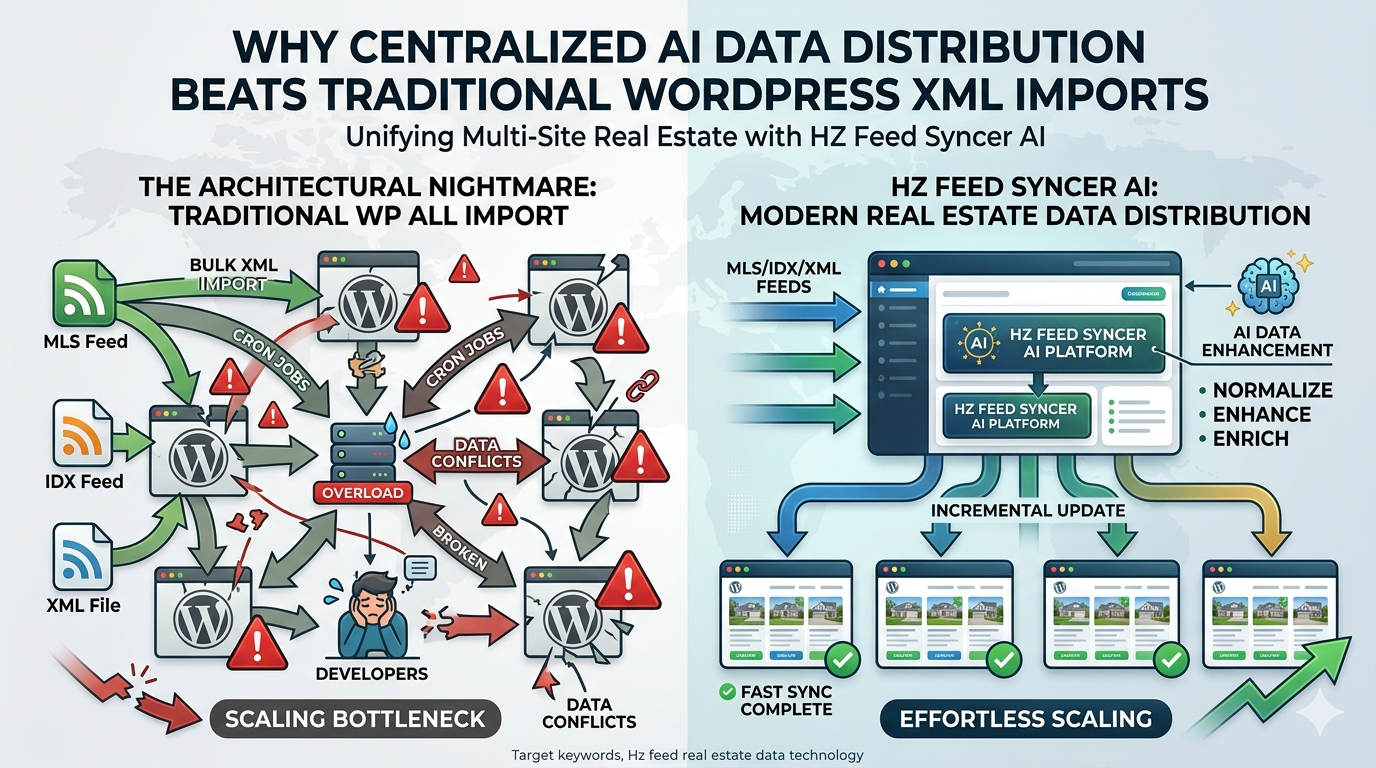
Why Centralized AI Data Distribution Beats Traditional WordPress XML Imports for Multi-Site Real Estate

Real estate agencies, property listing portals, and multi-branch brokerage networks increasingly operate across multiple websites—each targeting different cities, languages, or buyer segments.

But most teams still rely on outdated workflows like:

  • Separate WordPress installs per site
  • WP All Import XML cron jobs
  • Manual MLS/IDX feed uploads
  • Duplicated database imports across servers
  • Heavy nightly sync scripts

This creates an architectural mess that becomes harder to maintain as the business scales.

If you are searching for:

  • Centralized real estate feed automation
  • HZ Feed Syncer AI overview
  • WP All Import real estate alternatives
  • MLS IDX XML synchronization system
  • Multi-site property listing automation
  • Real estate data distribution platform
  • AI property feed normalization system
  • Centralized WordPress listing sync

then this guide explains why traditional XML import pipelines fail at scale and how a centralized AI-powered feed distribution architecture solves the problem permanently.


The Hidden Problem with Traditional WordPress XML Imports

At first, XML imports seem simple:

  • Upload MLS feed
  • Run WP All Import
  • Generate listings
  • Repeat for each site

But in a multi-site real estate ecosystem, this quickly becomes a maintenance nightmare.

Each website ends up running:

  • Independent cron jobs
  • Separate import schedules
  • Duplicated feed parsing logic
  • Inconsistent field mapping rules
  • Repeated error handling systems

Instead of a unified system, you get fragmented data pipelines across multiple servers.


Why Multi-Site Real Estate Architectures Break at Scale

When managing 5, 10, or even 50 real estate websites, traditional XML import systems fail in predictable ways:

  • Server overload from simultaneous imports
  • Slow cron execution and timeouts
  • Duplicate or missing listings across sites
  • Broken image synchronization
  • Inconsistent pricing updates
  • Out-of-sync availability data
  • High maintenance overhead

Each site becomes its own isolated data silo.


The Real Bottleneck: Repeated Data Processing

The biggest inefficiency in traditional setups is simple:

The same XML/MLS data is being processed multiple times for multiple websites.

This means:

  • Repeated parsing
  • Repeated transformation
  • Repeated validation
  • Repeated storage operations

All consuming unnecessary compute resources and increasing sync delays.


Introducing Centralized AI Feed Distribution Architecture

A modern alternative is a centralized feed processing system where all real estate data is handled once, normalized, enhanced, and distributed efficiently.

This is where platforms like HZ Feed Syncer introduce a new architectural model.

Instead of multiple WordPress imports, you operate a single intelligent cloud pipeline that:

  • Ingests MLS/IDX/XML feeds once
  • Normalizes all property data centrally
  • Applies AI enrichment and cleanup
  • Pushes optimized updates to multiple websites
  • Tracks synchronization status in real time

What Is HZ Feed Syncer?

HZ Feed Syncer is a centralized AI-powered real estate data distribution system designed to replace fragmented WordPress import workflows.

Instead of relying on individual plugins like WP All Import on each site, it introduces a unified control layer that manages everything from a single dashboard.


How HZ Feed Syncer Works

  1. Connect MLS/IDX/XML feed sources
  2. Normalize raw property data into a unified schema
  3. Apply AI enhancement (titles, descriptions, tags)
  4. Detect changes using incremental diffing
  5. Push updates to multiple WordPress sites via API
  6. Sync only changed fields (not full imports)

The Key Innovation: Incremental AI Syncing

Traditional imports reload entire datasets repeatedly.

HZ Feed Syncer instead uses incremental synchronization:

  • Only changed listings are updated
  • Only modified fields are transmitted
  • Unchanged properties are skipped entirely
  • Images are cached and reused intelligently

This dramatically reduces:

  • Server load
  • Bandwidth usage
  • Import time
  • Error rate

AI Enhancement Layer for Real Estate Data

Raw MLS/IDX data is often inconsistent and unoptimized.

A centralized AI layer can automatically improve:

  • Property titles
  • SEO descriptions
  • Location summaries
  • Amenity tagging
  • Category classification
  • Keyword optimization

Example transformation:

“3BR Condo Downtown”  

becomes:

Modern 3-Bedroom Downtown Condo with City Views, Balcony & Parking

This improves SEO performance across all connected websites instantly.


Centralized vs Traditional Architecture

Traditional WordPress XML Imports

  • Multiple cron jobs per site
  • Repeated processing per website
  • High server resource usage
  • Inconsistent data sync
  • Manual debugging per site

HZ Feed Syncer Centralized Model

  • Single ingestion pipeline
  • One normalization engine
  • AI-powered enrichment layer
  • Multi-site distribution system
  • Centralized monitoring dashboard

Multi-Site Sync Architecture Overview

  1. MLS / IDX feeds → Central cloud ingestion
  2. Data normalization engine processes listings
  3. AI layer enriches and structures content
  4. Change detection system identifies updates
  5. Distribution engine pushes updates to sites
  6. WordPress sites receive lightweight API updates

Why This Beats WP All Import

WP All Import is powerful for single-site use cases, but it struggles in multi-site environments because:

  • Each site runs independent imports
  • No centralized intelligence layer
  • No shared caching system
  • No cross-site synchronization control
  • No incremental global diffing engine

HZ Feed Syncer replaces this with a cloud-native architecture built for scale.


Performance Benefits of Centralized Syncing

  • Up to 80–95% reduction in redundant processing
  • Faster listing updates across all websites
  • Lower server costs
  • Improved uptime stability
  • Reduced maintenance complexity
  • Unified data governance

SEO Advantage of AI-Optimized Listings

When all sites receive AI-enhanced listings, you achieve:

  • Consistent keyword optimization
  • Better structured content across domains
  • Improved Google indexing quality
  • Reduced duplicate content issues
  • Stronger long-tail keyword coverage

Use Cases for Centralized Real Estate Sync

  • Multi-city brokerage websites
  • Franchise real estate agencies
  • International property portals
  • Vacation rental networks
  • MLS aggregation platforms
  • Real estate SaaS companies

Example Multi-Site Distribution Flow

  1. MLS feed updates a property price
  2. Central system detects change
  3. AI regenerates optimized description if needed
  4. Only changed fields are sent
  5. All connected WordPress sites update instantly

Why Work With Me?

I specialize in:

  • Centralized real estate feed architectures
  • MLS/IDX/XML normalization systems
  • AI-powered property data enrichment
  • Multi-site WordPress synchronization
  • High-performance data distribution pipelines
  • Real estate SaaS infrastructure design

With experience in:

  • WordPress multi-site systems
  • Large-scale data synchronization
  • API-first architecture design
  • Redis and queue-based pipelines
  • Programmatic SEO for real estate

I help real estate businesses move from fragmented import systems to scalable, centralized AI-powered data distribution platforms built for long-term growth.


Frequently Asked Questions

Q: Why are XML imports not scalable for multi-site real estate?
Because each site runs independent imports, causing duplicated processing, inconsistencies, and higher server load.

Q: How does centralized syncing improve performance?
It processes data once and distributes only incremental updates to all connected sites.

Q: Can AI improve property listing quality?
Yes. AI can enhance descriptions, tags, SEO structure, and categorization automatically.

Q: Does this replace WP All Import?
Yes in multi-site architectures. WP All Import becomes unnecessary when using a centralized feed engine.

Q: Is this suitable for large real estate networks?
Yes. It is specifically designed for scaling across multiple websites and regions.


Ready to Build a Centralized Real Estate Data System?

If you need help with:

  • Centralized MLS/IDX feed architecture
  • AI-powered real estate data enrichment
  • Multi-site WordPress synchronization
  • HZ Feed Syncer-style systems
  • Real estate API distribution platforms
  • Scalable property listing infrastructure

đŸ“© Contact me on Upwork to discuss your project.

🎯 Order on Fiverr for custom real estate feed automation and AI synchronization systems.

Multi-Tenant Lead Routing: How to Automatically Manage Agents

Real estate agent feed syndication, Centralized CRM lead distribution app

Managing Agents and Routing Leads Across Multi-Tenant Networks Automatically

Modern real estate networks are no longer single websites with a single CRM. They are multi-tenant ecosystems consisting of brokerage portals, franchise sites, regional microsites, and listing hubs—all generating leads independently.

The problem is not lead generation anymore. The real challenge is:

How do you correctly route each lead to the right agent in real time, across multiple disconnected systems?

If you are searching for:

  • Real estate agent feed syndication
  • Centralized CRM lead distribution app
  • Multi-tenant real estate CRM routing system
  • AI lead matching for real estate agents
  • Automated property inquiry assignment system
  • Cross-site real estate lead synchronization
  • Brokerage-wide agent data distribution platform

this guide explains how HZ Feed Syncer connects agents, listings, and lead flows into a unified AI-driven routing layer that works across multiple websites and CRMs instantly.


The Core Problem: Fragmented Agent and Listing Data

In most real estate organizations, data is split across:

  • Multiple WordPress or IDX websites
  • Independent CRM systems
  • Regional brokerage databases
  • Third-party listing portals

This creates a broken ecosystem where:

  • Agents are not consistently mapped to listings
  • Leads arrive without proper ownership assignment
  • Duplicate agent profiles exist across systems
  • Response times vary dramatically between offices

The result is lost revenue and inconsistent customer experience.


HZ Feed Syncer: The Centralized Agent + Listing Sync Layer

HZ Feed Syncer acts as a central intelligence layer that synchronizes:

  • Agent profiles
  • Property listings
  • Lead metadata
  • CRM endpoints
  • Office-level routing rules

Instead of each website operating independently, all systems pull from a unified data graph.


How Agent Data Synchronization Works

The system continuously aggregates agent data from multiple sources:

  • Broker CRM systems
  • WordPress agent directories
  • Franchise databases
  • Manual admin updates

Then it normalizes and standardizes this data into a unified schema:

  • Agent specialties (luxury, rentals, commercial)
  • Geographic coverage zones
  • Active listing assignments
  • Performance and response metrics
  • CRM endpoint configuration

Bridging Listings and Agents Across Multi-Site Networks

Once both listings and agents are unified, HZ Feed Syncer creates dynamic relationships between them:

  • Each listing is mapped to relevant agents
  • Agents are assigned based on territory and expertise
  • Listings inherit routing rules automatically
  • Cross-site visibility is synchronized in real time

This ensures consistency across every satellite website in the network.


The AI Layer: Intelligent Lead Matching Engine

The most powerful component is AI Lead Matching.

Instead of sending leads randomly or based on static rules, the system analyzes user behavior in real time and matches them with the most suitable agent.


How AI Lead Matching Works

  1. A user submits an inquiry or browsing session on a property site
  2. The system captures behavioral signals (views, filters, dwell time)
  3. AI builds a real-time intent profile of the user
  4. The system compares this profile with active agent data
  5. Best-fit agent is selected based on relevance scoring
  6. Lead is instantly pushed to the agent’s CRM endpoint

Behavioral Signals Used for Matching

The AI engine evaluates multiple signals, including:

  • Property type preference (apartment, villa, commercial)
  • Budget range interaction
  • Location search patterns
  • Time spent on specific listings
  • Repeat visits to property pages
  • Filter usage behavior (beds, amenities, price sliders)

This creates a highly accurate intent-based lead profile.


Agent Matching Intelligence Model

Each agent is scored dynamically using:

  • Specialization alignment (luxury, rentals, etc.)
  • Geographic coverage match
  • Current workload balancing
  • Historical conversion performance
  • Response speed metrics

The AI selects the agent with the highest relevance score at the exact moment the lead is generated.


Real-Time CRM Routing System

Once an agent is selected, HZ Feed Syncer pushes the lead into their CRM system instantly.

This may include:

  • HubSpot pipelines
  • Custom Laravel CRMs
  • Salesforce integrations
  • WordPress CRM plugins
  • Broker proprietary systems

All routing is API-driven and event-based.


Multi-Tenant Network Advantage

This system is designed specifically for multi-site real estate organizations where:

  • Each branch has its own website
  • Agents operate across regions
  • Listings are shared or syndicated
  • Leads originate from multiple entry points

Instead of siloed lead handling, everything flows into one intelligent routing layer.


Example Lead Flow in Action

  1. User searches “2-bedroom apartment near downtown”
  2. User spends time on luxury apartment listings
  3. System detects budget + location + intent signals
  4. AI identifies Agent A as luxury downtown specialist
  5. Lead is assigned to Agent A’s CRM instantly
  6. Agent receives full behavioral profile, not just form data

Why Traditional Lead Assignment Systems Fail

Most systems rely on:

  • Round-robin assignment
  • Manual selection
  • Static zip-code mapping
  • Simple form-based routing

This leads to:

  • Mismatched leads
  • Slow response times
  • Lost conversion opportunities
  • Uneven agent workloads

AI-Powered Advantage: Context-Rich Lead Delivery

Instead of sending just a name and email, HZ Feed Syncer sends:

  • Full browsing behavior profile
  • Viewed properties list
  • Budget inference
  • Location interest map
  • Engagement score

This allows agents to respond with highly personalized outreach.


Scalability for Brokerage Networks

The system is designed for:

  • Multi-office brokerage firms
  • Franchise real estate networks
  • International property groups
  • High-volume listing portals

It supports millions of leads and listings across distributed systems.


Why Work With Me?

I specialize in building:

  • AI lead routing and matching systems
  • Real estate CRM synchronization platforms
  • Multi-tenant agent data architectures
  • Cross-site listing distribution networks
  • Behavior-driven lead scoring engines
  • API-first real estate automation systems

With experience in:

  • Event-driven backend systems
  • Real-time data pipelines
  • CRM API integrations (HubSpot, Salesforce, custom)
  • Real estate data modeling and normalization
  • Scalable cloud orchestration systems

I help real estate organizations transform fragmented agent networks into unified, AI-powered lead distribution ecosystems that maximize conversion efficiency.


Frequently Asked Questions

Q: What is AI lead matching in real estate?
It is a system that analyzes user behavior and matches leads to the most suitable agent automatically.

Q: How is this different from round-robin assignment?
Instead of random distribution, leads are assigned based on relevance, behavior, and agent expertise.

Q: Can this integrate with existing CRMs?
Yes. It supports HubSpot, Salesforce, and custom CRM APIs.

Q: Does it work across multiple websites?
Yes. It is designed specifically for multi-tenant real estate networks.

Q: What data is sent to agents?
Agents receive full behavioral context, not just basic contact details.


Ready to Build an AI Lead Routing System?

If you need help with:

  • Real estate AI lead matching systems
  • Multi-tenant CRM routing architectures
  • Agent-listing synchronization platforms
  • Cross-site lead distribution systems
  • Behavior-based lead scoring engines

đŸ“© Contact me on Upwork to discuss your project.

🎯 Order on Fiverr for custom AI real estate CRM and lead routing automation systems.

Enhancing Multi-Site Property Galleries via Cloud AI

Real estate image optimization API, Centralized property media distribution

Smart Compression and Layouts: Enhancing Multi-Site Property Galleries via Cloud AI

In modern real estate platforms, visual presentation is not just decoration—it is a direct conversion factor. Listings with poorly ordered or slow-loading images consistently underperform in search rankings, engagement, and lead generation.

Most MLS and IDX feeds deliver raw image sets with no optimization, no hierarchy, and no performance tuning.

If you are searching for:

  • Real estate image optimization API
  • Centralized property media distribution
  • AI property photo sorting system
  • Automated real estate gallery optimization
  • Fast-loading IDX image pipeline
  • Computer vision property image ranking
  • Cloud-based media compression system

this guide explains how HZ Feed Syncer uses AI-driven computer vision and next-gen compression pipelines to transform chaotic property media into structured, high-performance visual experiences across multi-site real estate networks.


The Core Problem: Raw Property Images Are Unstructured and Heavy

Typical MLS feeds include:

  • 10–50+ images per listing
  • Random upload order from agents
  • Mixed quality resolutions
  • Unoptimized file sizes
  • No semantic labeling

This creates two major issues:

  • Poor user experience due to irrelevant first impressions
  • Slow page performance due to uncompressed media

In real estate, the first image decides whether a user continues scrolling or leaves the page.


The AI Solution: Visual Intelligence for Property Media

HZ Feed Syncer applies computer vision models to analyze every image in a listing and automatically determine its role in the gallery sequence.

Instead of relying on manual sorting, the system evaluates visual features such as:

  • Structural composition (interior vs exterior)
  • Room type classification (kitchen, bedroom, bathroom)
  • Aesthetic quality (lighting, clarity, framing)
  • Depth and spatial openness
  • Architectural prominence

Hero Shot Detection: Choosing the Most Impactful First Image

The system prioritizes selecting a hero image—the most visually compelling representation of the property.

Common hero candidates include:

  • Front exterior facade
  • Modern kitchen with wide-angle lighting
  • Luxury living room with open space design
  • Pool or outdoor landscape view

The AI ranks images based on engagement prediction scores and places the highest-value visual as image #1.


Computer Vision Pipeline for Image Classification

  1. Property images are ingested from MLS/IDX feeds
  2. Vision model analyzes scene type (interior/exterior)
  3. Object recognition identifies room category
  4. Quality scoring evaluates sharpness and composition
  5. Semantic labeling assigns metadata tags
  6. Ranking engine orders images by conversion potential

Smart Gallery Ordering Strategy

After classification, images are automatically arranged using a structured layout logic:

  • Image 1: Hero exterior or best interior highlight
  • Image 2–3: Primary living spaces (kitchen, living room)
  • Image 4–6: Bedrooms and bathrooms
  • Image 7+: Supporting spaces (hallways, storage, utilities)

This ensures every listing follows a psychologically optimized viewing flow.


Why Image Order Directly Impacts Conversions

User behavior data consistently shows:

  • Listings with strong hero images receive higher click-through rates
  • Properly ordered galleries increase time-on-page
  • Visually coherent flows improve inquiry rates

Bad image ordering creates cognitive friction, causing users to abandon listings prematurely.


Next-Gen Programmatic Image Compression Engine

Beyond sorting, HZ Feed Syncer applies intelligent compression pipelines to ensure fast-loading galleries across all devices and platforms.

Unlike basic compression tools, this system dynamically adjusts optimization based on image role and usage context.


Adaptive Compression Logic

  • Hero images: higher quality retention (visual priority)
  • Secondary images: balanced compression
  • Supporting images: aggressive size reduction

This ensures performance without sacrificing visual impact.


Multi-Format Optimization for Modern Web Performance

The system automatically converts images into next-generation formats:

  • WebP for fast web delivery
  • AVIF for ultra-compression efficiency
  • Fallback JPEG/PNG for compatibility

This reduces bandwidth usage significantly while improving load speed.


Centralized Media Distribution System

Instead of each WordPress or Shopify site handling images independently, HZ Feed Syncer centralizes media processing:

  • One optimized image pipeline
  • Shared CDN-ready assets
  • Pre-processed image variants
  • Consistent delivery across all platforms

This eliminates redundant processing and ensures consistency across multi-site networks.


Performance Benefits of AI-Optimized Media

Implementing smart image compression and layout optimization leads to:

  • Faster page load speeds
  • Lower bounce rates
  • Improved mobile performance
  • Higher Google PageSpeed scores
  • Better SEO ranking signals

Architecture Overview

  1. MLS feed delivers raw image sets
  2. Cloud AI analyzes and classifies images
  3. Hero image selection engine ranks visuals
  4. Compression engine optimizes file sizes
  5. CDN distributes optimized media globally
  6. Frontend sites load pre-processed galleries

Scalability for Large Real Estate Networks

This system is designed to handle:

  • Thousands of listings per hour
  • Millions of image assets
  • Multi-region CDN distribution
  • Multi-site synchronization architectures

Processing is handled in distributed cloud pipelines to prevent bottlenecks.


Why Work With Me?

I specialize in building:

  • AI-driven real estate image optimization systems
  • Computer vision-based property media pipelines
  • Cloud CDN media distribution architectures
  • MLS/IDX image processing engines
  • High-performance multi-site property platforms
  • Automated gallery ranking systems for real estate

With expertise in:

  • Computer vision and image classification models
  • Cloud-based media processing systems
  • Real estate data infrastructure
  • Performance optimization for large-scale listings
  • API-driven media transformation pipelines

I help real estate platforms turn unstructured MLS image dumps into fast, intelligent, conversion-optimized visual experiences across all digital channels.


Frequently Asked Questions

Q: What is real estate image optimization API?
It is a system that processes, compresses, and enhances property images automatically before serving them to websites.

Q: How does AI choose the first image in a listing?
Computer vision models rank images based on visual quality, room type, and conversion potential.

Q: Does image compression reduce quality?
No. Adaptive compression preserves hero image quality while optimizing secondary images more aggressively.

Q: Can this improve SEO performance?
Yes. Faster load times and better engagement signals improve search rankings.

Q: Is this scalable for large MLS feeds?
Yes. The system is designed for high-volume, multi-site real estate platforms.


Ready to Build an AI-Powered Property Media System?

If you need help with:

  • Real estate image optimization APIs
  • AI-based gallery sorting systems
  • MLS/IDX media processing pipelines
  • Cloud-based compression and CDN systems
  • Multi-site property media distribution architecture

đŸ“© Contact me on Upwork to discuss your project.

🎯 Order on Fiverr for custom AI real estate media optimization and computer vision pipeline development.

Moving from Heavy WordPress XML Imports to HZ Feed Syncer

Real estate XML feed server load, Automate MLS sync without crashing WordPress

Stop Crashing Your Servers: Moving from Heavy WordPress XML Imports to HZ Feed Syncer

Real estate platforms, MLS aggregators, and multi-site WordPress networks often start with a simple idea:

“We’ll just import XML feeds into WordPress and automate everything.”

But at scale—50,000+ listings, multiple feed sources, and frequent updates—this approach becomes a performance bottleneck that quietly destroys server stability.

If you are searching for:

  • Real estate XML feed server load
  • Automate MLS sync without crashing WordPress
  • WP All Import performance issues real estate
  • Large-scale IDX feed processing solution
  • Multi-site property sync optimization
  • Real estate data pipeline architecture
  • AI-powered feed validation system

then this guide explains why traditional XML imports overload WordPress—and how HZ Feed Syncer offloads processing into a scalable AI-driven cloud layer.


The Real Problem: WordPress Is Not a Data Processing Engine

WordPress was never designed to handle continuous ingestion of massive structured datasets like MLS or IDX feeds.

When XML imports run locally on your server, WordPress is forced to:

  • Parse large XML files line-by-line
  • Create or update thousands of posts
  • Process metadata and taxonomies repeatedly
  • Handle image downloads and resizing
  • Run cron-based background jobs under load

On a small site this works. On a real estate platform with 50,000+ listings, it becomes unstable very quickly.


Why Heavy XML Imports Crash Real Estate Servers

Traditional WP All Import or custom XML pipelines often fail due to:

  • Memory exhaustion during large parsing operations
  • PHP timeout limits on long-running imports
  • MySQL write bottlenecks during bulk updates
  • Image processing overload (thousands of media files)
  • Concurrent cron jobs overlapping execution

The result is predictable:

  • Slow dashboards
  • Failed imports
  • Partial updates
  • Site downtime during sync cycles

The Architectural Shift: Offloading Processing to the Cloud

The modern solution is not to “optimize WordPress imports”—it is to remove them entirely from the critical path.

This is where HZ Feed Syncer introduces a fundamentally different architecture.

Instead of WordPress doing all the heavy lifting, HZ Feed Syncer acts as a centralized processing layer that handles:

  • MLS / IDX / XML ingestion
  • Data normalization
  • Image validation and optimization
  • Change detection and diffing
  • AI-based data enrichment

WordPress becomes a lightweight display layer—not a processing engine.


How HZ Feed Syncer Architecture Works

  1. External feeds are pulled via JSON/XML APIs
  2. Raw listings are stored in a centralized ingestion layer
  3. Data is normalized into a unified schema
  4. AI processing engine enhances and validates content
  5. Only optimized incremental updates are sent to WordPress sites

This removes heavy computation from every individual website.


Before vs After Architecture Comparison

Traditional WordPress XML Import Model

  • Each WordPress site runs full XML parsing
  • Duplicate processing across multiple servers
  • High CPU and memory usage per site
  • Slow cron-based updates
  • Risk of import collisions

HZ Feed Syncer Cloud Model

  • Single centralized ingestion pipeline
  • One-time parsing of all feed data
  • Optimized incremental updates
  • Lightweight WordPress sync requests
  • No heavy cron jobs on individual sites

How AI Prevents Broken Real Estate Data from Going Live

One of the most powerful upgrades in HZ Feed Syncer is AI-driven anomaly detection.

Instead of blindly pushing XML data into production, the system actively scans for issues such as:

  • Empty or missing price fields
  • Corrupted or broken image URLs
  • Invalid bedroom/bathroom values
  • Duplicate or conflicting listings
  • Malformed address structures
  • Unrealistic pricing anomalies

This ensures bad data never reaches live websites.


Example: AI Anomaly Detection Layer

A listing might arrive like this:

{
  "title": "Luxury Villa",
  "price": "",
  "images": ["broken-link.jpg"],
  "bedrooms": "NaN"
}

Instead of pushing this to WordPress, the AI system flags it:

  • Missing price detected → blocked or queued for review
  • Invalid image URL → replaced or removed
  • Invalid numeric field → corrected or rejected

This prevents broken listings from affecting user trust and SEO performance.


Incremental Syncing: The Key to Server Stability

Instead of re-importing 50,000 listings repeatedly, HZ Feed Syncer uses incremental updates.

This means:

  • Only changed listings are processed
  • Only modified fields are transmitted
  • Unchanged data is ignored
  • Updates are lightweight and fast

This dramatically reduces server load on WordPress sites.


Why This Approach Eliminates Server Crashes

By moving processing outside WordPress, you eliminate the root causes of crashes:

  • No large XML parsing inside PHP
  • No heavy media processing during imports
  • No long-running cron jobs
  • No bulk database write spikes
  • No concurrent import conflicts

WordPress only receives clean, pre-processed updates.


Real Estate Data Flow in HZ Feed Syncer

  1. MLS feeds → cloud ingestion layer
  2. AI normalization engine processes listings
  3. Anomaly detection validates data quality
  4. Change detection system identifies updates
  5. Optimized payload sent to WordPress sites
  6. Sites update instantly without heavy processing

Performance Gains Compared to WP All Import

  • Up to 90% reduction in server CPU usage
  • Massive reduction in memory spikes
  • Faster update cycles across all sites
  • No downtime during feed refreshes
  • Improved frontend stability

SEO Advantage of Clean, AI-Validated Listings

Search engines reward clean, structured, consistent data.

With HZ Feed Syncer, every listing is:

  • Structured consistently
  • Free of missing fields
  • Optimized for metadata
  • Enriched with AI-generated context

This improves:

  • Indexing reliability
  • Keyword relevance
  • Page quality signals
  • Organic ranking performance

Scalable Architecture for Enterprise Real Estate Networks

This system is designed for:

  • Multi-site brokerage firms
  • International property portals
  • MLS aggregators
  • Real estate SaaS platforms
  • High-volume listing networks

It scales without increasing load on WordPress infrastructure.


Why Work With Me?

I specialize in:

  • Real estate feed architecture design
  • MLS/IDX/XML ingestion pipelines
  • AI-powered data validation systems
  • Multi-site WordPress synchronization
  • High-performance cloud data distribution
  • Server load optimization for large listing platforms

With experience in:

  • Enterprise WordPress scaling
  • Redis and queue-based processing systems
  • API-first real estate infrastructure
  • Programmatic SEO for property platforms
  • Large-scale data normalization engines

I help real estate businesses eliminate server crashes by moving from heavy XML imports to scalable, AI-powered centralized feed distribution systems.


Frequently Asked Questions

Q: Why do XML imports crash WordPress servers?
Because they require heavy parsing, database writes, and media processing that exceed PHP and server limits.

Q: How does HZ Feed Syncer reduce load?
It moves all heavy processing to a centralized cloud system and only sends optimized updates to WordPress.

Q: What is AI anomaly detection in real estate feeds?
It automatically detects and blocks broken or invalid listing data before it reaches production websites.

Q: Does this replace WP All Import?
Yes, in large-scale multi-site architectures it replaces repeated import workflows entirely.

Q: Is this suitable for 50,000+ listings?
Yes. It is specifically designed for high-volume real estate data pipelines.


Ready to Build a Scalable Real Estate Feed System?

If you need help with:

  • MLS / IDX feed architecture design
  • AI-powered real estate data validation
  • Multi-site WordPress synchronization
  • HZ Feed Syncer-style cloud pipelines
  • Server load optimization for real estate platforms
  • Scalable property listing infrastructure

đŸ“© Contact me on Upwork to discuss your project.

🎯 Order on Fiverr for custom real estate feed automation and AI-driven synchronization systems.

Hz Feed Syncer – Real-Time Property Data Sync for WordPress (Houzez, Homey, WP Residence & More)

Hz Feed Syncer – Real-Time Property Data Sync for WordPress (Houzez, Homey, WP Residence & More)

In 2026, real estate platforms are no longer built manually—they are powered by data automation. Whether your listings come from a CRM, MLS feed, XML endpoint, or custom API, managing them manually inside WordPress is inefficient and error-prone.

Hz Feed Syncer is a powerful middleware solution designed to import, normalize, and sync property data from multiple sources directly into WordPress themes like Houzez, Homey, WP Residence, and more—in real time, without slowing down your website.


The Problem with Traditional Property Imports

Most real estate websites struggle with outdated or inefficient data workflows:

  • Manual CSV/XML imports that break layouts
  • Inconsistent property data across sources
  • Slow cron jobs that delay updates
  • Missing SEO metadata (image alt, captions, schema)
  • Performance issues when handling large datasets

These limitations affect not just operations—but also search rankings, user experience, and lead generation.


What Is Hz Feed Syncer?

Hz Feed Syncer is a custom-built data synchronization engine that acts as a bridge between your external data sources and your WordPress real estate website.

It supports:

  • REST APIs (JSON-based endpoints)
  • XML feeds (IDX, MLS, custom feeds)
  • CSV and database exports
  • CRM systems and SaaS platforms
  • Custom proprietary data sources

Instead of relying on one source, it allows multi-source aggregation into a single unified system.


Multi-Source Data Aggregation (Core Strength)

Hz Feed Syncer can connect to multiple data providers simultaneously:

  • CRM A → Residential listings
  • API B → Rental properties
  • XML Feed C → Commercial properties

All data is merged, normalized, and published into WordPress as a single clean dataset.

This eliminates duplication, conflicts, and inconsistencies.


Real-Time Sync Without Slowing Down Your Website

Handling thousands of properties requires performance-focused architecture. Hz Feed Syncer uses:

  • Chunk-Based Processing: Data is processed in small batches
  • Background Jobs (Queues): No heavy operations during page load
  • Smart Diff Updates: Only changed data is updated

This ensures:

  • No server overload
  • No downtime during sync
  • Consistent website performance

Data Normalization Engine

Different sources use different formats. Hz Feed Syncer standardizes everything:

  • Price formats (USD, EUR, etc.)
  • Area units (sqft, sqm)
  • Property types and categories
  • Custom fields and taxonomies

This creates a clean, structured dataset ready for frontend display and SEO.


SEO Optimization Built Into the Sync Process

Unlike basic import tools, Hz Feed Syncer enhances your listings for search engines:

  • Auto-generate image ALT tags
  • Set image captions and metadata
  • Optimize titles and descriptions
  • Structured data readiness (schema support)
  • Clean URL and slug generation

This ensures your listings are not just visible—but rankable.


Real-Time Updates (Instant Reflection)

Any change in the source data reflects instantly on your website:

  • Price updates
  • Availability changes
  • Image modifications
  • Description edits

No delays, no manual refresh—your website is always 100% in sync.


Supported WordPress Themes

Hz Feed Syncer is built for flexibility and supports:

  • Houzez
  • Homey
  • WP Residence
  • MyHome
  • RealHomes
  • Custom-built themes

It maps data directly into each theme’s structure, including custom fields and taxonomies.


How Hz Feed Syncer Works (Technical Workflow)

  1. Source Connection: Connect APIs, XML feeds, or CRM endpoints
  2. Data Fetching: Pull data in scheduled or real-time intervals
  3. Normalization: Convert data into a unified schema
  4. SEO Enrichment: Add metadata, alt tags, and optimized content
  5. Chunk Processing: Process data in batches for performance
  6. Publishing: Insert/update listings in WordPress

Sample Code: Fetch & Process API Data (PHP)


function fetch_and_sync_properties() {

    $response = wp_remote_get('https://api.example.com/properties');
    $data = json_decode(wp_remote_retrieve_body($response), true);

    foreach ($data as $property) {

        $normalized = normalize_property($property);

        wp_insert_post([
            'post_title'   => $normalized['title'],
            'post_content' => $normalized['description'],
            'post_type'    => 'property',
            'meta_input'   => $normalized['meta']
        ]);
    }
}

Core Features of Hz Feed Syncer

  • Multi-Source Data Integration: APIs, XML, CSV, CRM systems
  • Real-Time Sync Engine: Instant updates across listings
  • SEO Data Enrichment: Optimized metadata and images
  • Performance Optimization: Chunk processing and queues
  • Theme Compatibility: Works with all major real estate themes

Why Custom Feed Syncer Beats Standard Plugins

Generic plugins are limited to basic imports. Hz Feed Syncer provides:

  • Full control over data logic
  • Advanced mapping and transformations
  • Scalable architecture for large datasets
  • Support for any API or feed format

Why Work With Me?

I specialize in real estate data integration and WordPress automation systems. With 10+ years of experience and 1000+ integrations delivered, I build scalable sync engines that power high-performance property platforms.

I don’t just import data—I build intelligent systems that grow your business.


Frequently Asked Questions

Q: Can Hz Feed Syncer handle multiple APIs at once?
Yes. It is designed to fetch and merge data from multiple sources simultaneously.

Q: Will it slow down my WordPress site?
No. It uses background processing and chunk-based updates to maintain performance.

Q: Does it support Houzez and other themes?
Yes. It supports Houzez, Homey, WP Residence, and custom themes.

Q: Is SEO handled automatically?
Yes. Image metadata, titles, and descriptions are optimized during sync.


Ready to Automate Your Property Data?

If you want a real-time, scalable solution to manage property listings across multiple sources, Hz Feed Syncer is the answer.

đŸ“© Contact me on Upwork to build your custom property sync system.