
Automate Your Auto Parts Business: API, AI & Multi-Channel Listing System for eBay Motors, WooCommerce & Shopify
In 2026, successful auto parts businesses are no longer built on manual listings. They are powered by automation, API integrations, and AI-driven content systems.
If you’re still uploading products one by one, fixing titles manually, and managing stock separately across platforms—you’re not just wasting time, you’re limiting your growth.
A modern auto parts automation system transforms your workflow into a scalable engine that handles listings, fitment, SEO, and inventory sync automatically.
The Hidden Cost of Manual Listing
Most sellers on marketplaces are still stuck in outdated workflows:
- Manual product uploads
- Copy-paste descriptions
- Separate inventory tracking
- Incorrect fitment data
These issues lead to:
- Overselling and stock mismatches
- Wrong compatibility → returns & negative feedback
- Poor SEO visibility
- Slow scaling
Manual work is not a strategy—it’s a bottleneck.
What a Modern Auto Parts Automation System Looks Like
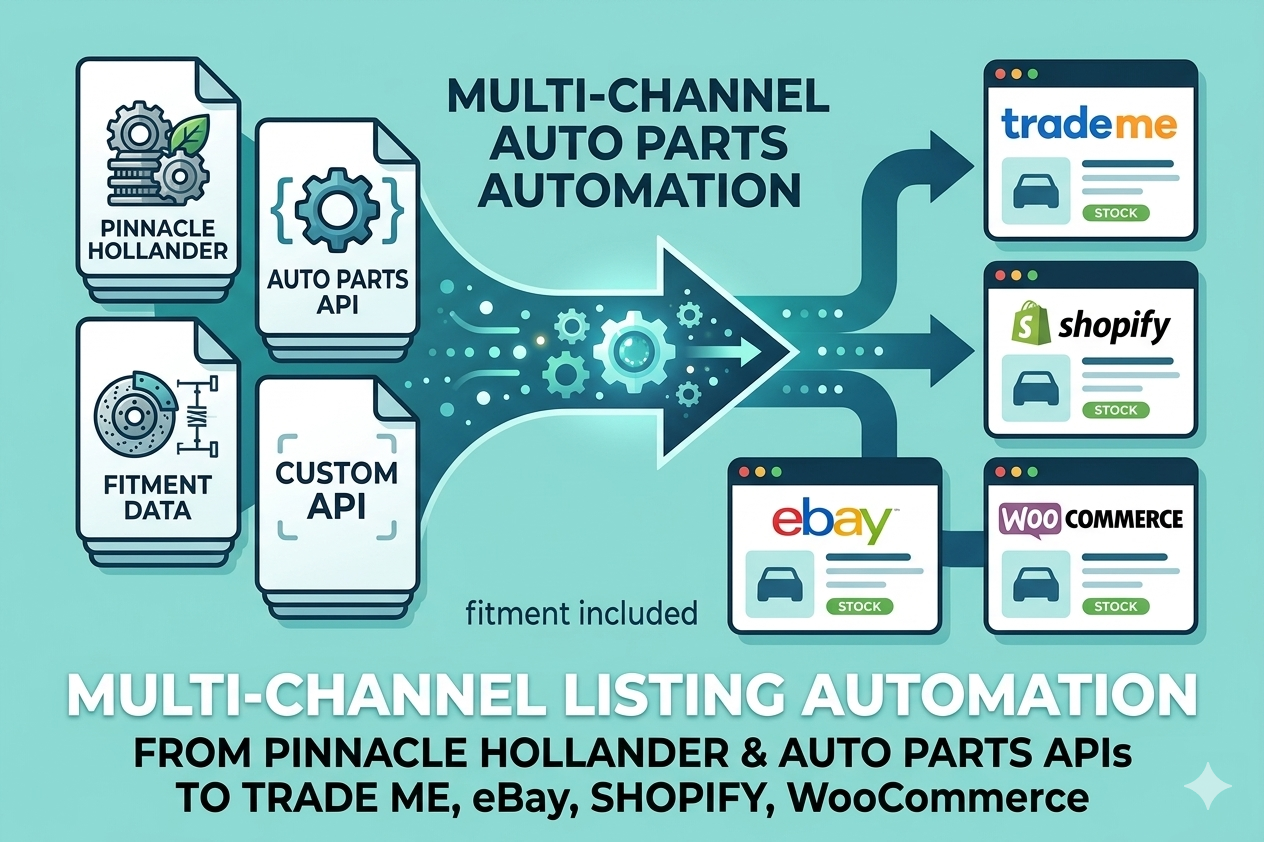
A scalable system connects your inventory source to multiple sales channels while optimizing your data for performance and conversions.
Instead of working manually, your system works for you.
How the Automation Workflow Works (End-to-End)
- Data Extraction: Pull inventory from systems like Pinnacle, Hollander, or custom datasets
- Normalization: Clean and structure raw data into a unified schema
- AI Enrichment: Rewrite titles, descriptions, and SEO metadata automatically
- Fitment Mapping: Ensure accurate vehicle compatibility and item specifics
- Bulk Listing Engine: Publish listings in batches across platforms
- Inventory Sync: Keep stock updated across all connected channels
- Order Sync: Send sales back to source system for fulfillment or dropshipping
AI-Powered Listing Optimization (Conversion Engine)
Raw auto parts data is not ready for customers. AI transforms it into high-performing listings:
- High-converting product titles
- SEO-optimized descriptions
- Structured item specifics
- Keyword targeting for marketplace ranking
This ensures your listings are searchable, readable, and conversion-focused.
Fitment & Compatibility (Critical for Auto Parts)
Accuracy is everything in the auto parts industry.
- Vehicle compatibility (Year / Make / Model)
- Structured fitment data
- Correct part matching
This reduces returns, improves trust, and increases conversions.
Multi-Channel Listing & Inventory Sync
A true automation system connects your business across multiple platforms:
- WooCommerce (WordPress)
- Shopify
- eBay Motors
- Trade Me
- Custom marketplaces
Core benefits:
- Centralized inventory management
- Automatic stock updates
- Prevention of overselling
- Unified product data
Bulk Listing System (Scale Without Limits)
Instead of listing products one by one:
- Upload hundreds or thousands of parts at once
- Use structured workflows for consistency
- Automate listing creation and updates
This is how real businesses scale.
Order Sync & Dropshipping Workflow
Automation doesn’t stop at listing—it continues after the sale:
- Orders are captured from all platforms
- Stock is reduced across all channels
- Order data is sent back to source system
- Supports dropshipping workflows
This creates a closed-loop inventory system.
Who This System Is Built For
- Auto parts sellers
- Salvage yards / wreckers / dismantlers
- eBay Motors businesses
- Multi-channel eCommerce stores
- High-volume inventory sellers
Core Features of the System
- API-based data integration
- AI-powered listing generation
- Fitment & compatibility mapping
- Bulk product listing engine
- Multi-channel inventory sync
- Order synchronization (two-way)
- Centralized product management
Sample Code: Auto Parts Sync Logic (PHP)
function sync_auto_parts($parts) {
foreach ($parts as $part) {
$optimized = ai_generate_content($part);
$product_id = wp_insert_post([
'post_title' => $optimized['title'],
'post_type' => 'product',
'post_status' => 'publish'
]);
update_post_meta($product_id, 'price', $part['price']);
update_post_meta($product_id, 'fitment', $part['fitment']);
send_to_marketplaces($optimized);
}
}
Why This Matters for Growth
- Speed: List products faster than competitors
- Accuracy: Reduce errors and returns
- SEO: Improve visibility and ranking
- Scalability: Handle thousands of products effortlessly
Why Work With Me?
I build custom automotive middleware and automation systems that connect inventory sources with global marketplaces.
With 10+ years of experience and 1000+ integrations delivered, I specialize in building scalable, high-performance solutions for auto parts businesses.
Frequently Asked Questions (FAQ)
Q: Can I automate listings from Pinnacle or Hollander?
Yes. Inventory can be extracted, processed, and listed automatically.
Q: Can this sync inventory across multiple platforms?
Yes. Stock updates in real time across all connected channels.
Q: Does it support bulk listing?
Yes. Thousands of products can be listed efficiently.
Q: Can orders sync back to my system?
Yes. Two-way sync ensures orders are sent back for processing or dropshipping.
Ready to Scale Your Auto Parts Business?
If you want to move from manual work to a fully automated system, this is the next step.
Automotive Data Integration Guide (2026): Global Inventory Sources & Marketplaces for Auto Parts Selling
In 2026, the automotive parts industry is no longer limited by geography. Whether you operate in the USA, UK, Europe, Australia, or the Middle East, success depends on one thing: how efficiently you connect your inventory sources with global selling platforms.
Auto recyclers, dismantlers, and parts sellers are moving toward fully automated, API-driven ecosystems that allow them to pull inventory from systems like Pinnacle and Hollander and distribute it worldwide across marketplaces and eCommerce stores.
This guide covers all major automotive data sources and global selling platforms—helping you understand how to build a scalable, international parts business.
Understanding the Global Automotive Data Ecosystem
The system works in two layers:
- Inventory Sources – Where your parts data originates
- Sales Channels – Where your parts are listed and sold
A modern integration connects both layers using middleware and APIs, enabling real-time, global distribution.
Global Auto Parts Inventory Sources (Data Providers)
These are the systems used worldwide by recyclers, dismantlers, suppliers, and OEM networks:
Enterprise Yard Management Systems
- Pinnacle Professional (Solera) – Widely used in the US, UK, and global recycling networks
- Hollander Interchange – Industry-standard parts compatibility system
- Powerlink / Checkmate – Legacy systems used in large recycling yards
Modern Cloud-Based Platforms
- GreenSpark – Cloud-native recycling platform with REST APIs
- PartsTech – Supplier aggregation platform for repair shops
- Car-Part.com – Global inventory distribution network
OEM & Aftermarket Data Providers
- TecDoc – Global aftermarket catalog used across Europe and beyond
- AutoCare ACES/PIES – Standardized product and fitment data (USA)
- OEM Dealer Systems – Manufacturer-specific parts databases
Custom & Internal Data Sources
- Custom CRMs and ERP systems
- XML / JSON API endpoints
- CSV / Excel feeds
- FTP-based data exports
- Google Sheets / internal databases
Each source uses different formats, requiring data normalization and mapping before distribution.
Global Auto Parts Marketplaces & Sales Channels
Once your data is structured, it can be distributed globally across multiple high-traffic platforms:
Global Marketplaces
- eBay Motors – Leading global automotive marketplace
- Amazon Automotive – Expanding rapidly in structured parts listings
- AliExpress / Alibaba – Cross-border B2C and B2B sales
Regional Marketplaces (Worldwide)
- Trade Me Motors (New Zealand)
- Gumtree (UK, AU)
- Leboncoin (France)
- Mobile.de (Germany)
- Subito (Italy)
- Dubizzle (UAE & Middle East)
- OLX (Multiple countries)
- Facebook Marketplace (Global)
eCommerce Platforms
- WooCommerce (WordPress)
- Shopify
- Magento / Adobe Commerce
- BigCommerce
Custom Platforms
- Custom automotive marketplaces
- B2B wholesale portals
- Dealer-specific online stores
This allows businesses to reach buyers across multiple countries simultaneously.
The Biggest Problem: Fragmented Systems
Without integration, businesses face:
- Manual listing creation across platforms
- Inconsistent product data
- Stock mismatches and overselling
- Delayed updates across regions
- Limited global reach
This creates operational bottlenecks and limits growth.
The Solution: Global API-Driven Middleware
A centralized system connects everything:
- Pulls data from Pinnacle, Hollander, APIs, XML feeds
- Normalizes and structures inventory data
- Enhances listings using AI
- Pushes products to global marketplaces
- Syncs orders and inventory in real time
This turns your business into a global, automated distribution engine.
AI-Powered Optimization for Global Reach
To compete internationally, listings must be optimized:
- SEO-friendly titles and descriptions
- Localized keywords for different regions
- Structured fitment data (Year / Make / Model)
- Optimized images with ALT tags
This improves visibility across search engines and marketplace algorithms.
Technical Workflow (Global Architecture)
- Extract Data – From ERP, CRM, API, or feeds
- Normalize – Standardize all inventory data
- Enrich – AI optimization for SEO and readability
- Map – Align categories and attributes per platform
- Distribute – Push listings globally
- Sync – Real-time inventory and order updates
Who Needs This System?
- Auto recyclers and dismantlers
- Parts exporters and wholesalers
- Multi-channel eCommerce sellers
- Automotive SaaS startups
Why This Matters for Growth
- Global Reach – Sell across multiple countries
- Higher Conversions – Optimized listings perform better
- Efficiency – Eliminate manual processes
- Scalability – Handle thousands of SKUs easily
Why Work With Me?
I specialize in building global automotive API integrations that connect inventory sources with marketplaces worldwide.
With 1000+ integrations delivered, I design systems that are scalable, automated, and built for international growth.
Frequently Asked Questions (FAQ)
Q: Can I sell globally using one system?
Yes. Middleware allows you to distribute inventory across multiple countries and platforms.
Q: Do I need API access for all systems?
Not always. XML, CSV, and database exports can also be integrated.
Q: Can this work with Shopify and WooCommerce?
Yes. Both platforms support full API-based automation.
Q: How do I manage stock globally?
Through real-time synchronization across all connected platforms.
Ready to Scale Your Auto Parts Business Globally?
If you want to connect your inventory with global marketplaces and automate your operations, a centralized integration system is essential.