
Why Publishing Raw Feed Data Hurts SEO ?
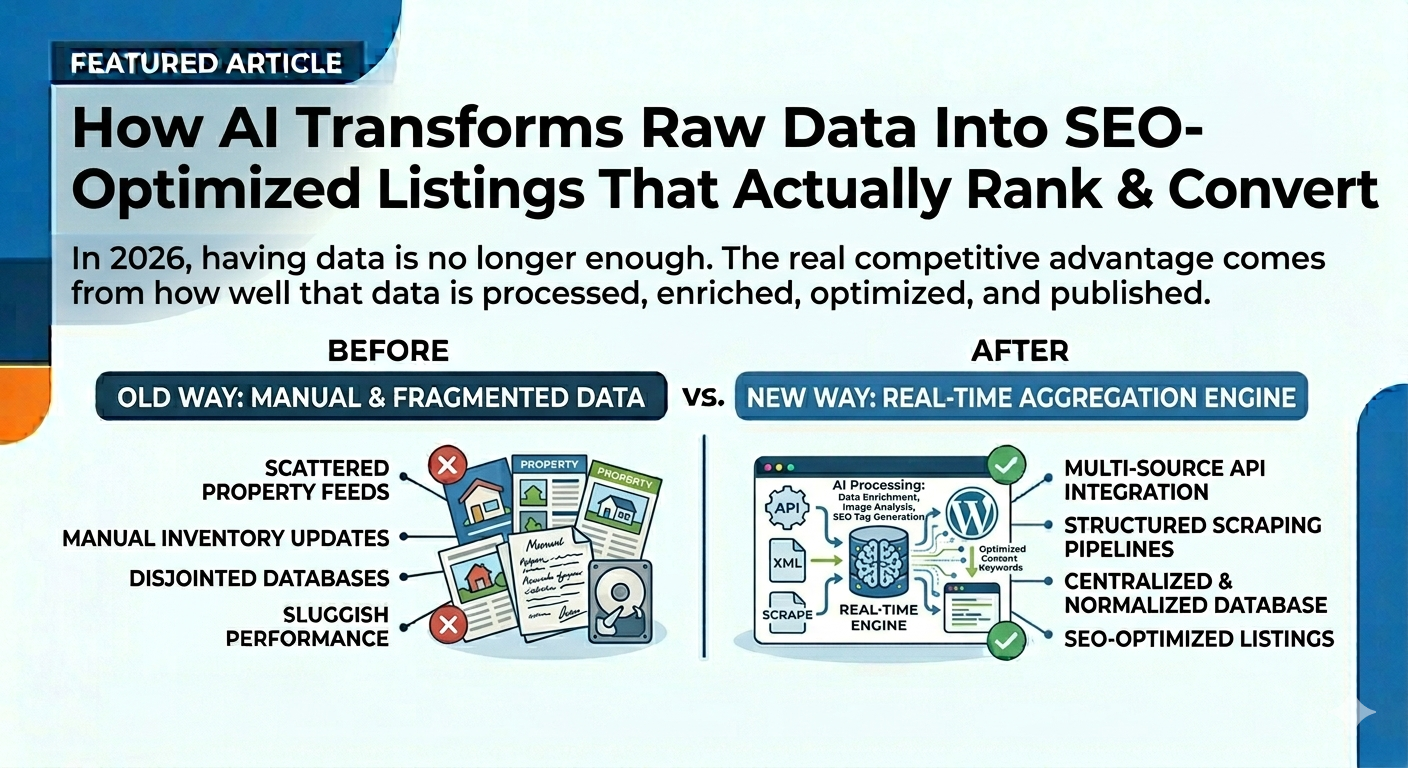
How AI Transforms Raw Data Into SEO-Optimized Listings That Actually Rank & Convert
In 2026, having data is no longer enough.
The real competitive advantage comes from how well that data is processed, enriched, optimized, and published.
Across industries like:
- real estate
- automotive parts
- ecommerce
- marketplaces
- classified platforms
- travel & hospitality
most businesses already have access to massive amounts of inventory data through APIs, XML feeds, CRMs, spreadsheets, or supplier systems.
But there is one major problem:
Raw data is terrible for SEO.
And businesses that publish raw feed content without enrichment are losing rankings, visibility, and conversions to competitors using AI-powered optimization workflows.
The Hidden SEO Problem With Raw Imported Data
Most APIs, XML feeds, and CRM exports are designed for data exchange — not search engine optimization.
That means imported listings often contain:
- generic titles
- duplicate descriptions
- missing keywords
- poor formatting
- technical abbreviations
- thin content
- missing metadata
Examples of raw imported content often look like this:
| Industry | Raw Imported Data |
|---|---|
| Real Estate | Apartment Sale NewYork 2 Bed Bath Train |
| Auto Parts | ALT ASM 2AZFE 08 CAM |
| Hospitality | STD RM DBL BRKFST |
To humans, this looks incomplete.
To Google, it looks even worse.
Why Publishing Raw Feed Data Hurts SEO
Most businesses using direct feed imports or generic sync plugins unknowingly create:
- duplicate content
- low-quality pages
- keyword-poor listings
- thin descriptions
- poor click-through rates
- weak internal relevance
As a result:
- pages struggle to rank
- buyers skip listings
- Google sees low-value content
- marketplace visibility decreases
This is one of the biggest hidden SEO problems in automated import systems.
The Difference Between “Imported Data” vs “AI-Enriched Data”
Modern AI-powered import systems do far more than simply sync data.
They transform raw inventory into:
- search-optimized listings
- conversion-focused content
- structured SEO pages
- marketplace-friendly product data
This process is called AI enrichment.
Example: Real Estate SEO Transformation
Raw Imported Property Title
Apartment Sale NewYork 2 Bed Bath Train
AI-Optimized SEO Title
Luxury 2 Bedroom Apartment for Sale in Manhattan New York Near Subway Station
AI Improvements
- location optimization
- buyer intent targeting
- natural language formatting
- high-volume SEO keywords
- improved readability
The result is a listing that both Google and buyers understand instantly.
Example: Automotive Parts SEO Transformation
Raw Inventory Data
ALT ASM 2AZFE 08 CAM
AI-Rewritten Product Listing
2008 Toyota Camry 2.4L Alternator OEM Genuine Tested Used Auto Part
AI Enhancements Include
- vehicle year extraction
- make & model formatting
- part identification
- SEO keyword enrichment
- buyer-friendly readability
- marketplace optimization
This dramatically improves:
- search discoverability
- click-through rates
- marketplace visibility
- buyer trust
How AI Improves SEO During Auto Sync Imports
Modern import systems no longer simply “sync data.”
Instead, they process data through multiple AI enrichment layers before publishing.
Step 1: Fetch Raw Data
Import data from:
- APIs
- XML feeds
- JSON endpoints
- CRMs
- CSV files
- ERPs
- supplier systems
Step 2: Normalize Structure
Different feeds use different formats.
The system standardizes:
- titles
- attributes
- categories
- location data
- vehicle data
- pricing structures
Step 3: AI Rewriting & SEO Enrichment
AI models like:
- ChatGPT
- Claude
- Gemini
can automatically generate:
- SEO titles
- subtitles
- meta descriptions
- long-form descriptions
- keyword enrichment
- structured formatting
- localized content
Step 4: Media SEO Optimization
AI can also optimize:
- image ALT tags
- captions
- image filenames
- OpenGraph metadata
- schema markup
This improves both:
- image SEO
- accessibility
Step 5: Publish Across Multiple Platforms
Optimized content can then be pushed automatically to:
- WordPress
- WooCommerce
- Shopify
- Houzez
- WP Residence
- eBay Motors
- Trade Me
- Allegro
- custom websites
- marketplaces
Why AI-Optimized Listings Outperform Raw Feed Listings
| Raw Imported Listings | AI-Enriched Listings |
|---|---|
| Generic titles | SEO-focused titles |
| Thin descriptions | Rich buyer-focused content |
| Low readability | Natural language optimization |
| Poor indexing | Structured SEO pages |
| Weak CTR | Higher engagement potential |
Businesses using AI enrichment gain a major advantage over competitors simply importing data “as-is.”
Industries Benefiting Most From AI SEO Enrichment
Real Estate
- property feed imports
- CRM listing synchronization
- location-based SEO pages
Automotive Parts
- YMM fitment optimization
- OEM part rewriting
- marketplace listing automation
Ecommerce
- supplier feed optimization
- product enrichment
- AI-generated descriptions
Hospitality
- hotel room descriptions
- Beds24 property optimization
- booking SEO improvements
The Future of SEO Is AI-Powered Data Enrichment
Search engines increasingly reward:
- structured content
- high-quality descriptions
- semantic relevance
- user-focused readability
- fresh optimized content
Businesses relying on raw imports will continue struggling against competitors using AI-enhanced workflows.
The future is not manual SEO writing.
The future is automated AI-powered SEO enrichment at scale.
Why Work With Me?
I specialize in building AI-powered import & sync systems that transform raw feed data into SEO-optimized, conversion-focused listings automatically.
With 10+ years of API integration experience, I help businesses:
- import data from any source
- normalize large datasets
- rewrite listings using AI
- improve SEO automatically
- sync inventory in real time
- publish optimized listings across platforms
Supported systems include:
- WordPress
- WooCommerce
- Shopify
- Houzez
- Homey
- WP Residence
- custom SaaS platforms
Frequently Asked Questions (FAQ)
Q: Can AI automatically rewrite imported listings for SEO?
Yes. AI models can optimize titles, descriptions, metadata, and structured content automatically.
Q: Does AI enrichment work for property listings?
Yes. AI can improve real estate titles, amenities, descriptions, and location-based SEO content.
Q: Can AI improve auto parts inventory data?
Yes. AI can process YMM fitment data, OEM references, and raw inventory into marketplace-friendly listings.
Q: Can this work with XML, API, CSV, or CRM feeds?
Yes. AI enrichment can be integrated into almost any import or synchronization workflow.
Q: Does this help improve Google rankings?
Yes. Better content structure, keyword optimization, and enriched listings improve SEO performance significantly.
Ready to Transform Raw Data Into SEO-Optimized Listings?
Your data already has value.
The real advantage comes from how intelligently that data is processed, enriched, and published.
AI-powered SEO automation helps businesses outperform competitors still relying on raw imports and manual workflows.
📩 Contact me on Upwork to build an AI-powered import & SEO enrichment system.
🎯 Order on Fiverr for API integrations, AI rewriting systems, feed automation, and real-time synchronization workflows.