Is Your Responsive Website Costing You Mobile Customers? (The Mobile Web vs Mobile App Conversion Gap)

Many business owners believe that having a responsive website means their mobile experience is fully optimized.

But in 2026, being “mobile-friendly” is no longer enough.

Modern users expect:

And this is exactly where most responsive websites fail.

Businesses across ecommerce, real estate, SaaS, booking systems, food delivery, marketplaces, and service industries are now discovering a major hidden problem:

Mobile websites often convert significantly worse than mobile apps.

This article explains:


The Myth of “My Website Is Responsive, So I’m Fine”

For years, businesses invested heavily in responsive web design.

The logic was simple:

“If the website looks good on mobile, users will convert.”

But user behavior changed.

Today’s customers compare your mobile experience not against other websites — but against apps like:

And apps create a fundamentally different experience.

Even a beautifully responsive website still suffers from limitations that mobile apps eliminate.


The Real Mobile Web vs Mobile App Conversion Gap

Businesses often notice:

The reason is friction.

Every extra step reduces conversions.

On mobile browsers, users constantly deal with:

Even small interruptions drastically impact mobile behavior.


Why Mobile Apps Convert Better

Mobile apps reduce friction dramatically.

Users can:

This creates:


The Hidden Friction Killing Mobile Sales

1. Browser Fatigue

Mobile users constantly switch tabs.

Your website competes against:

Once the browser closes, many users never return.

Apps remain visible directly on the device home screen.


2. Slower Mobile Performance

Even optimized responsive websites still rely on:

Apps feel faster because they:

Speed directly affects:


3. No Push Notifications

This is one of the biggest differences.

Responsive websites cannot compete with app notifications.

Push notifications allow businesses to:

For many industries, push notifications dramatically outperform email marketing.


4. Poor User Retention

Websites are temporary experiences.

Apps become permanent customer touchpoints.

Once installed, your business stays visible on the customer’s device every day.

This increases:


5. Weak Offline Experience

Traditional websites fail when internet connections become unstable.

Apps can still provide:

This becomes especially important for:


Why Businesses Are Converting Websites Into Mobile Apps

Businesses increasingly want:

Instead of rebuilding systems from scratch, many companies now convert existing platforms into mobile apps.

This allows businesses to transform:


Progressive Web Apps (PWA) vs Native Mobile Apps

Many businesses first explore Progressive Web Apps (PWAs).

PWAs improve some browser limitations by adding:

But native mobile apps still provide:

The best solution depends on:


Industries Seeing Huge Results From Mobile Apps

App conversion improvements are especially strong for:


Features Businesses Want in Modern Mobile Apps


Modern Website-to-App Architecture

Today’s mobile app systems often connect directly with:

This allows businesses to keep:


The Future Is App-Centered Customer Retention

The biggest difference between websites and apps is not just technology.

It is customer retention.

Websites attract traffic.

Apps build long-term engagement ecosystems.

Businesses that continue relying only on responsive websites may increasingly struggle with:

Meanwhile, businesses using mobile apps gain:


Why Work With Me?

I specialize in:

With experience building scalable automation systems, APIs, and synchronization platforms, I help businesses transform traditional websites into high-converting mobile app ecosystems.


Frequently Asked Questions (FAQ)

Q: Why do mobile apps convert better than websites?
Apps reduce friction by offering faster access, push notifications, smoother navigation, and persistent user sessions.

Q: Can I convert my WooCommerce or Shopify store into an app?
Yes. Existing WooCommerce and Shopify stores can be transformed into mobile applications using APIs and synchronization systems.

Q: What is the difference between a PWA and a native app?
PWAs improve browser experiences, while native apps provide deeper device integration, better performance, and stronger engagement features.

Q: Can apps synchronize with my existing website in real time?
Yes. Modern mobile apps can synchronize inventory, orders, users, and content directly with your website backend.

Q: Are push notifications really effective?
Yes. Push notifications often outperform email marketing for engagement, retention, and abandoned cart recovery.


Ready to Convert Your Website Into a High-Converting Mobile App?

If you are looking for:

📩 Schedule a meeting on Upwork to discuss your project.

🎯 Schedule a meeting on Fiverr for custom mobile app development and website-to-app conversion services.


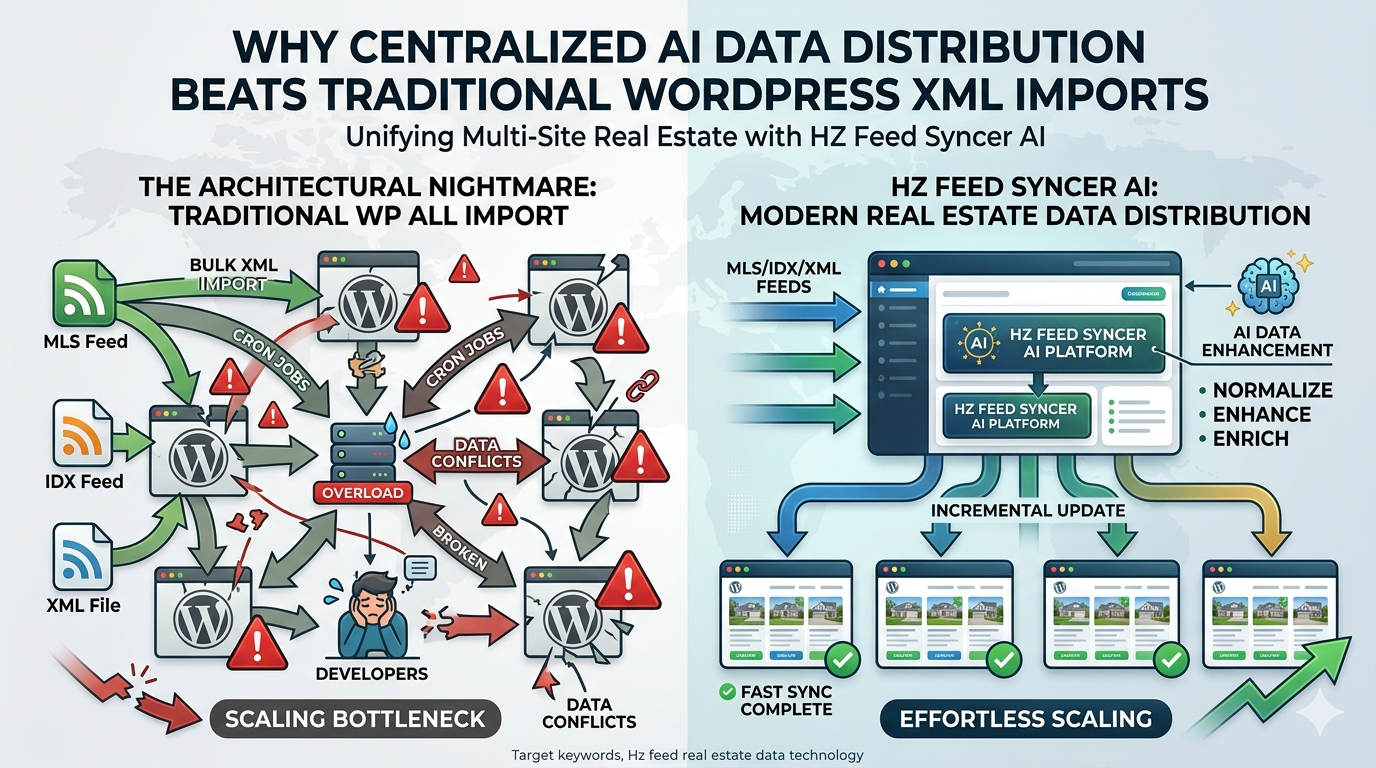
Why Centralized AI Data Distribution Beats Traditional WordPress XML Imports for Multi-Site Real Estate

Real estate agencies, property listing portals, and multi-branch brokerage networks increasingly operate across multiple websites—each targeting different cities, languages, or buyer segments.

But most teams still rely on outdated workflows like:

This creates an architectural mess that becomes harder to maintain as the business scales.

If you are searching for:

then this guide explains why traditional XML import pipelines fail at scale and how a centralized AI-powered feed distribution architecture solves the problem permanently.


The Hidden Problem with Traditional WordPress XML Imports

At first, XML imports seem simple:

But in a multi-site real estate ecosystem, this quickly becomes a maintenance nightmare.

Each website ends up running:

Instead of a unified system, you get fragmented data pipelines across multiple servers.


Why Multi-Site Real Estate Architectures Break at Scale

When managing 5, 10, or even 50 real estate websites, traditional XML import systems fail in predictable ways:

Each site becomes its own isolated data silo.


The Real Bottleneck: Repeated Data Processing

The biggest inefficiency in traditional setups is simple:

The same XML/MLS data is being processed multiple times for multiple websites.

This means:

All consuming unnecessary compute resources and increasing sync delays.


Introducing Centralized AI Feed Distribution Architecture

A modern alternative is a centralized feed processing system where all real estate data is handled once, normalized, enhanced, and distributed efficiently.

This is where platforms like HZ Feed Syncer introduce a new architectural model.

Instead of multiple WordPress imports, you operate a single intelligent cloud pipeline that:


What Is HZ Feed Syncer?

HZ Feed Syncer is a centralized AI-powered real estate data distribution system designed to replace fragmented WordPress import workflows.

Instead of relying on individual plugins like WP All Import on each site, it introduces a unified control layer that manages everything from a single dashboard.


How HZ Feed Syncer Works

  1. Connect MLS/IDX/XML feed sources
  2. Normalize raw property data into a unified schema
  3. Apply AI enhancement (titles, descriptions, tags)
  4. Detect changes using incremental diffing
  5. Push updates to multiple WordPress sites via API
  6. Sync only changed fields (not full imports)

The Key Innovation: Incremental AI Syncing

Traditional imports reload entire datasets repeatedly.

HZ Feed Syncer instead uses incremental synchronization:

This dramatically reduces:


AI Enhancement Layer for Real Estate Data

Raw MLS/IDX data is often inconsistent and unoptimized.

A centralized AI layer can automatically improve:

Example transformation:

“3BR Condo Downtown”  

becomes:

Modern 3-Bedroom Downtown Condo with City Views, Balcony & Parking

This improves SEO performance across all connected websites instantly.


Centralized vs Traditional Architecture

Traditional WordPress XML Imports


HZ Feed Syncer Centralized Model


Multi-Site Sync Architecture Overview

  1. MLS / IDX feeds → Central cloud ingestion
  2. Data normalization engine processes listings
  3. AI layer enriches and structures content
  4. Change detection system identifies updates
  5. Distribution engine pushes updates to sites
  6. WordPress sites receive lightweight API updates

Why This Beats WP All Import

WP All Import is powerful for single-site use cases, but it struggles in multi-site environments because:

HZ Feed Syncer replaces this with a cloud-native architecture built for scale.


Performance Benefits of Centralized Syncing


SEO Advantage of AI-Optimized Listings

When all sites receive AI-enhanced listings, you achieve:


Use Cases for Centralized Real Estate Sync


Example Multi-Site Distribution Flow

  1. MLS feed updates a property price
  2. Central system detects change
  3. AI regenerates optimized description if needed
  4. Only changed fields are sent
  5. All connected WordPress sites update instantly

Why Work With Me?

I specialize in:

With experience in:

I help real estate businesses move from fragmented import systems to scalable, centralized AI-powered data distribution platforms built for long-term growth.


Frequently Asked Questions

Q: Why are XML imports not scalable for multi-site real estate?
Because each site runs independent imports, causing duplicated processing, inconsistencies, and higher server load.

Q: How does centralized syncing improve performance?
It processes data once and distributes only incremental updates to all connected sites.

Q: Can AI improve property listing quality?
Yes. AI can enhance descriptions, tags, SEO structure, and categorization automatically.

Q: Does this replace WP All Import?
Yes in multi-site architectures. WP All Import becomes unnecessary when using a centralized feed engine.

Q: Is this suitable for large real estate networks?
Yes. It is specifically designed for scaling across multiple websites and regions.


Ready to Build a Centralized Real Estate Data System?

If you need help with:

📩 Contact me on Upwork to discuss your project.

🎯 Order on Fiverr for custom real estate feed automation and AI synchronization systems.

Why Native Keycafe API Integration Beats No-Code Tools for Custom Property Management Software

As property management companies scale their operations, many initially rely on Zapier, Make.com, Pabbly, or other no-code automation tools to connect booking systems with Keycafe SmartBoxes.

At small scale, these tools may appear convenient.

However, once businesses begin managing:

they quickly discover that no-code automation platforms create serious operational limitations.

If you are searching for:

then this guide explains why native API integration architecture is dramatically more reliable, scalable, and cost-effective than relying on no-code tools.


Why No-Code Automation Breaks at Scale

Platforms like Zapier are designed for lightweight business automation.

They work reasonably well for:

However, property management systems involve:

This is where no-code systems begin failing.


The Real Problem with Zapier for Keycafe Automation

Many agencies initially build workflows like:

  1. Booking created in PMS
  2. Zapier receives webhook
  3. Zapier calls Keycafe API
  4. Guest receives access code

At low volume, this seems acceptable.

But once businesses scale to:

Zapier workflows become unreliable and expensive.


Common Failures in No-Code Keycafe Workflows

Webhook Delays

No-code platforms often queue webhook events during traffic spikes.

This can cause:


Silent Workflow Failures

One of the biggest risks with Zapier-style systems is silent failure.

Examples include:

In many cases:


No Proper Error Recovery

Enterprise property systems require:

No-code tools are not designed for this level of operational resilience.


API Rate Limiting Problems

At enterprise scale, businesses often trigger:

Zapier-style systems commonly hit:


Why No-Code Automation Becomes Extremely Expensive

Most no-code platforms charge based on:

For property management businesses processing:

monthly costs can rapidly become extremely high.

Large PMS operators often discover they are paying:

while still lacking enterprise-grade reliability.


Why Native Keycafe API Integration Is Better

A native API integration connects your PMS directly to Keycafe without relying on third-party workflow tools.

This architecture provides:


What a Professional Integration Architecture Looks Like

Enterprise-grade property automation systems commonly use:

This creates a resilient integration hub between:


Example Enterprise Keycafe Workflow

  1. A guest books a property
  2. The PMS creates a reservation event
  3. The middleware validates booking data
  4. The system creates a Keycafe access window
  5. The guest receives pickup instructions
  6. Redis queues monitor synchronization
  7. Automatic retries handle failures
  8. Logs track every API transaction
  9. Staff dashboards monitor operational status

Why Queue Systems Matter for Property Automation

Enterprise systems cannot depend on instant webhook execution alone.

Professional infrastructure uses:

This prevents:


Custom Middleware vs Zapier

Feature Zapier / No-Code Custom Middleware
Scalability Limited Enterprise-grade
Error Recovery Basic Advanced retry systems
Queue Processing Minimal Full queue architecture
Monitoring Limited Real-time dashboards
API Control Restricted Fully customizable
Operational Cost High at scale Predictable infrastructure cost
Security Third-party dependency Direct infrastructure control
Performance Variable Optimized

Why Enterprise Property Managers Need Centralized Integration Hubs

Modern property businesses often operate:

A centralized integration hub enables:


Sample Native Keycafe Middleware Workflow (PHP)

class CreateKeycafeAccessJob implements ShouldQueue
{
    use Dispatchable, Queueable;

    public function handle()
    {
        $booking = Booking::find($this->bookingId);

        if (!$booking) {
            return;
        }

        Http::retry(5, 2000)
            ->withHeaders([
                'Authorization' => 'Bearer API_KEY'
            ])
            ->post(
                'https://api.keycafe.com/access',
                [
                    'guest_name' => $booking->guest_name,
                    'phone'      => $booking->phone,
                    'start_time' => $booking->checkin_at,
                    'end_time'   => $booking->checkout_at
                ]
            );
    }
}

Benefits of Custom PMS Keycafe API Integration


Who Needs Native Keycafe API Infrastructure?


Advanced Features Developers Can Build


Why Work With Me?

I specialize in:

With extensive experience in:

I help property businesses replace fragile no-code workflows with scalable enterprise-grade integration infrastructure.


Frequently Asked Questions

Q: Is Zapier reliable for enterprise Keycafe automation?
Zapier can work for small workflows, but enterprise-scale property systems typically require custom infrastructure for reliability and scalability.

Q: Why do no-code workflows fail at scale?
High API volume, webhook delays, missing retry systems, and operational complexity often cause failures in large automation environments.

Q: Can custom middleware reduce automation costs?
Yes. Native integrations usually become far more cost-effective than per-task no-code pricing at scale.

Q: What technologies are commonly used for enterprise integrations?
Laravel, Redis, queue workers, cloud middleware systems, webhook pipelines, and distributed processing infrastructure are commonly used.

Q: Can multiple property systems connect into one integration hub?
Yes. A centralized middleware architecture can synchronize PMS platforms, SmartBoxes, booking systems, cleaning workflows, and guest messaging systems.


Ready to Replace Fragile No-Code Automation?

If you need help with:

📩 Contact me on Upwork to discuss your project.

🎯 Order on Fiverr for custom Keycafe API integration and enterprise automation development services.

Managing Agents and Routing Leads Across Multi-Tenant Networks Automatically

Modern real estate networks are no longer single websites with a single CRM. They are multi-tenant ecosystems consisting of brokerage portals, franchise sites, regional microsites, and listing hubs—all generating leads independently.

The problem is not lead generation anymore. The real challenge is:

How do you correctly route each lead to the right agent in real time, across multiple disconnected systems?

If you are searching for:

this guide explains how HZ Feed Syncer connects agents, listings, and lead flows into a unified AI-driven routing layer that works across multiple websites and CRMs instantly.


The Core Problem: Fragmented Agent and Listing Data

In most real estate organizations, data is split across:

This creates a broken ecosystem where:

The result is lost revenue and inconsistent customer experience.


HZ Feed Syncer: The Centralized Agent + Listing Sync Layer

HZ Feed Syncer acts as a central intelligence layer that synchronizes:

Instead of each website operating independently, all systems pull from a unified data graph.


How Agent Data Synchronization Works

The system continuously aggregates agent data from multiple sources:

Then it normalizes and standardizes this data into a unified schema:


Bridging Listings and Agents Across Multi-Site Networks

Once both listings and agents are unified, HZ Feed Syncer creates dynamic relationships between them:

This ensures consistency across every satellite website in the network.


The AI Layer: Intelligent Lead Matching Engine

The most powerful component is AI Lead Matching.

Instead of sending leads randomly or based on static rules, the system analyzes user behavior in real time and matches them with the most suitable agent.


How AI Lead Matching Works

  1. A user submits an inquiry or browsing session on a property site
  2. The system captures behavioral signals (views, filters, dwell time)
  3. AI builds a real-time intent profile of the user
  4. The system compares this profile with active agent data
  5. Best-fit agent is selected based on relevance scoring
  6. Lead is instantly pushed to the agent’s CRM endpoint

Behavioral Signals Used for Matching

The AI engine evaluates multiple signals, including:

This creates a highly accurate intent-based lead profile.


Agent Matching Intelligence Model

Each agent is scored dynamically using:

The AI selects the agent with the highest relevance score at the exact moment the lead is generated.


Real-Time CRM Routing System

Once an agent is selected, HZ Feed Syncer pushes the lead into their CRM system instantly.

This may include:

All routing is API-driven and event-based.


Multi-Tenant Network Advantage

This system is designed specifically for multi-site real estate organizations where:

Instead of siloed lead handling, everything flows into one intelligent routing layer.


Example Lead Flow in Action

  1. User searches “2-bedroom apartment near downtown”
  2. User spends time on luxury apartment listings
  3. System detects budget + location + intent signals
  4. AI identifies Agent A as luxury downtown specialist
  5. Lead is assigned to Agent A’s CRM instantly
  6. Agent receives full behavioral profile, not just form data

Why Traditional Lead Assignment Systems Fail

Most systems rely on:

This leads to:


AI-Powered Advantage: Context-Rich Lead Delivery

Instead of sending just a name and email, HZ Feed Syncer sends:

This allows agents to respond with highly personalized outreach.


Scalability for Brokerage Networks

The system is designed for:

It supports millions of leads and listings across distributed systems.


Why Work With Me?

I specialize in building:

With experience in:

I help real estate organizations transform fragmented agent networks into unified, AI-powered lead distribution ecosystems that maximize conversion efficiency.


Frequently Asked Questions

Q: What is AI lead matching in real estate?
It is a system that analyzes user behavior and matches leads to the most suitable agent automatically.

Q: How is this different from round-robin assignment?
Instead of random distribution, leads are assigned based on relevance, behavior, and agent expertise.

Q: Can this integrate with existing CRMs?
Yes. It supports HubSpot, Salesforce, and custom CRM APIs.

Q: Does it work across multiple websites?
Yes. It is designed specifically for multi-tenant real estate networks.

Q: What data is sent to agents?
Agents receive full behavioral context, not just basic contact details.


Ready to Build an AI Lead Routing System?

If you need help with:

📩 Contact me on Upwork to discuss your project.

🎯 Order on Fiverr for custom AI real estate CRM and lead routing automation systems.

Smart Compression and Layouts: Enhancing Multi-Site Property Galleries via Cloud AI

In modern real estate platforms, visual presentation is not just decoration—it is a direct conversion factor. Listings with poorly ordered or slow-loading images consistently underperform in search rankings, engagement, and lead generation.

Most MLS and IDX feeds deliver raw image sets with no optimization, no hierarchy, and no performance tuning.

If you are searching for:

this guide explains how HZ Feed Syncer uses AI-driven computer vision and next-gen compression pipelines to transform chaotic property media into structured, high-performance visual experiences across multi-site real estate networks.


The Core Problem: Raw Property Images Are Unstructured and Heavy

Typical MLS feeds include:

This creates two major issues:

In real estate, the first image decides whether a user continues scrolling or leaves the page.


The AI Solution: Visual Intelligence for Property Media

HZ Feed Syncer applies computer vision models to analyze every image in a listing and automatically determine its role in the gallery sequence.

Instead of relying on manual sorting, the system evaluates visual features such as:


Hero Shot Detection: Choosing the Most Impactful First Image

The system prioritizes selecting a hero image—the most visually compelling representation of the property.

Common hero candidates include:

The AI ranks images based on engagement prediction scores and places the highest-value visual as image #1.


Computer Vision Pipeline for Image Classification

  1. Property images are ingested from MLS/IDX feeds
  2. Vision model analyzes scene type (interior/exterior)
  3. Object recognition identifies room category
  4. Quality scoring evaluates sharpness and composition
  5. Semantic labeling assigns metadata tags
  6. Ranking engine orders images by conversion potential

Smart Gallery Ordering Strategy

After classification, images are automatically arranged using a structured layout logic:

This ensures every listing follows a psychologically optimized viewing flow.


Why Image Order Directly Impacts Conversions

User behavior data consistently shows:

Bad image ordering creates cognitive friction, causing users to abandon listings prematurely.


Next-Gen Programmatic Image Compression Engine

Beyond sorting, HZ Feed Syncer applies intelligent compression pipelines to ensure fast-loading galleries across all devices and platforms.

Unlike basic compression tools, this system dynamically adjusts optimization based on image role and usage context.


Adaptive Compression Logic

This ensures performance without sacrificing visual impact.


Multi-Format Optimization for Modern Web Performance

The system automatically converts images into next-generation formats:

This reduces bandwidth usage significantly while improving load speed.


Centralized Media Distribution System

Instead of each WordPress or Shopify site handling images independently, HZ Feed Syncer centralizes media processing:

This eliminates redundant processing and ensures consistency across multi-site networks.


Performance Benefits of AI-Optimized Media

Implementing smart image compression and layout optimization leads to:


Architecture Overview

  1. MLS feed delivers raw image sets
  2. Cloud AI analyzes and classifies images
  3. Hero image selection engine ranks visuals
  4. Compression engine optimizes file sizes
  5. CDN distributes optimized media globally
  6. Frontend sites load pre-processed galleries

Scalability for Large Real Estate Networks

This system is designed to handle:

Processing is handled in distributed cloud pipelines to prevent bottlenecks.


Why Work With Me?

I specialize in building:

With expertise in:

I help real estate platforms turn unstructured MLS image dumps into fast, intelligent, conversion-optimized visual experiences across all digital channels.


Frequently Asked Questions

Q: What is real estate image optimization API?
It is a system that processes, compresses, and enhances property images automatically before serving them to websites.

Q: How does AI choose the first image in a listing?
Computer vision models rank images based on visual quality, room type, and conversion potential.

Q: Does image compression reduce quality?
No. Adaptive compression preserves hero image quality while optimizing secondary images more aggressively.

Q: Can this improve SEO performance?
Yes. Faster load times and better engagement signals improve search rankings.

Q: Is this scalable for large MLS feeds?
Yes. The system is designed for high-volume, multi-site real estate platforms.


Ready to Build an AI-Powered Property Media System?

If you need help with:

📩 Contact me on Upwork to discuss your project.

🎯 Order on Fiverr for custom AI real estate media optimization and computer vision pipeline development.

Stop Crashing Your Servers: Moving from Heavy WordPress XML Imports to HZ Feed Syncer

Real estate platforms, MLS aggregators, and multi-site WordPress networks often start with a simple idea:

“We’ll just import XML feeds into WordPress and automate everything.”

But at scale—50,000+ listings, multiple feed sources, and frequent updates—this approach becomes a performance bottleneck that quietly destroys server stability.

If you are searching for:

then this guide explains why traditional XML imports overload WordPress—and how HZ Feed Syncer offloads processing into a scalable AI-driven cloud layer.


The Real Problem: WordPress Is Not a Data Processing Engine

WordPress was never designed to handle continuous ingestion of massive structured datasets like MLS or IDX feeds.

When XML imports run locally on your server, WordPress is forced to:

On a small site this works. On a real estate platform with 50,000+ listings, it becomes unstable very quickly.


Why Heavy XML Imports Crash Real Estate Servers

Traditional WP All Import or custom XML pipelines often fail due to:

The result is predictable:


The Architectural Shift: Offloading Processing to the Cloud

The modern solution is not to “optimize WordPress imports”—it is to remove them entirely from the critical path.

This is where HZ Feed Syncer introduces a fundamentally different architecture.

Instead of WordPress doing all the heavy lifting, HZ Feed Syncer acts as a centralized processing layer that handles:

WordPress becomes a lightweight display layer—not a processing engine.


How HZ Feed Syncer Architecture Works

  1. External feeds are pulled via JSON/XML APIs
  2. Raw listings are stored in a centralized ingestion layer
  3. Data is normalized into a unified schema
  4. AI processing engine enhances and validates content
  5. Only optimized incremental updates are sent to WordPress sites

This removes heavy computation from every individual website.


Before vs After Architecture Comparison

Traditional WordPress XML Import Model


HZ Feed Syncer Cloud Model


How AI Prevents Broken Real Estate Data from Going Live

One of the most powerful upgrades in HZ Feed Syncer is AI-driven anomaly detection.

Instead of blindly pushing XML data into production, the system actively scans for issues such as:

This ensures bad data never reaches live websites.


Example: AI Anomaly Detection Layer

A listing might arrive like this:

{
  "title": "Luxury Villa",
  "price": "",
  "images": ["broken-link.jpg"],
  "bedrooms": "NaN"
}

Instead of pushing this to WordPress, the AI system flags it:

This prevents broken listings from affecting user trust and SEO performance.


Incremental Syncing: The Key to Server Stability

Instead of re-importing 50,000 listings repeatedly, HZ Feed Syncer uses incremental updates.

This means:

This dramatically reduces server load on WordPress sites.


Why This Approach Eliminates Server Crashes

By moving processing outside WordPress, you eliminate the root causes of crashes:

WordPress only receives clean, pre-processed updates.


Real Estate Data Flow in HZ Feed Syncer

  1. MLS feeds → cloud ingestion layer
  2. AI normalization engine processes listings
  3. Anomaly detection validates data quality
  4. Change detection system identifies updates
  5. Optimized payload sent to WordPress sites
  6. Sites update instantly without heavy processing

Performance Gains Compared to WP All Import


SEO Advantage of Clean, AI-Validated Listings

Search engines reward clean, structured, consistent data.

With HZ Feed Syncer, every listing is:

This improves:


Scalable Architecture for Enterprise Real Estate Networks

This system is designed for:

It scales without increasing load on WordPress infrastructure.


Why Work With Me?

I specialize in:

With experience in:

I help real estate businesses eliminate server crashes by moving from heavy XML imports to scalable, AI-powered centralized feed distribution systems.


Frequently Asked Questions

Q: Why do XML imports crash WordPress servers?
Because they require heavy parsing, database writes, and media processing that exceed PHP and server limits.

Q: How does HZ Feed Syncer reduce load?
It moves all heavy processing to a centralized cloud system and only sends optimized updates to WordPress.

Q: What is AI anomaly detection in real estate feeds?
It automatically detects and blocks broken or invalid listing data before it reaches production websites.

Q: Does this replace WP All Import?
Yes, in large-scale multi-site architectures it replaces repeated import workflows entirely.

Q: Is this suitable for 50,000+ listings?
Yes. It is specifically designed for high-volume real estate data pipelines.


Ready to Build a Scalable Real Estate Feed System?

If you need help with:

📩 Contact me on Upwork to discuss your project.

🎯 Order on Fiverr for custom real estate feed automation and AI-driven synchronization systems.

How to Programmatically Rewrite 10,000 MLS Listings with HZ Feed Syncer’s Integrated AI SEO Engine

Real estate platforms, MLS aggregators, and multi-site brokerage networks face a structural SEO problem that most operators don’t fully recognize until growth slows:

Thousands of listings are duplicated across the internet with identical descriptions.

Agent websites, IDX portals, and syndicated feeds often publish the exact same MLS text—resulting in weak search visibility, keyword cannibalization, and reduced organic performance.

If you are searching for:

this guide explains how HZ Feed Syncer transforms raw MLS data into unique, SEO-optimized, and hyper-local property descriptions using an integrated AI engine before distribution.


The Core Problem: Duplicate MLS Content Is Killing SEO

Most MLS feeds distribute standardized property descriptions that are reused across:

This leads to a major SEO issue:

Search engines see thousands of identical pages competing for the same keywords.

As a result:


Why Raw MLS Data Fails in Modern SEO Systems

MLS descriptions are typically:

Example of raw MLS content:

3 bedroom house with modern kitchen, close to schools and transport.

This same sentence may appear on hundreds of websites.


The AI Solution: Programmatic Listing Rewriting at Scale

HZ Feed Syncer introduces an AI-powered SEO transformation layer that rewrites every incoming MLS listing into a unique, structured, and localized version before publishing.

Instead of storing raw feed text, every listing is processed through a fine-tuned language model designed specifically for real estate content generation.


How the AI SEO Engine Works

  1. MLS feed is ingested into the central system
  2. Raw listing data is normalized into structured fields
  3. AI engine analyzes property attributes
  4. Localized context is injected (city, neighborhood, landmarks)
  5. Unique SEO-optimized description is generated
  6. Final content is distributed to all connected websites

What Makes This AI Layer Different from Generic LLMs

Unlike general-purpose AI tools, HZ Feed Syncer’s model is optimized specifically for:

This ensures every listing is not just rewritten—but strategically optimized for search engines.


Example: Before vs After AI Transformation

Raw MLS Input

Spacious 4 bedroom villa with garden, located near city center.

AI-Optimized Output

Elegant 4-Bedroom Family Villa with Private Garden Near City Center – Ideal for Modern Living in a Prime Urban Location

This rewritten version introduces:


How HZ Feed Syncer Prevents Duplicate Content Penalties

The system ensures uniqueness through multiple layers:

This reduces the risk of:


Hyper-Local SEO Injection Engine

One of the most powerful features is hyper-local context enrichment.

The AI automatically enhances listings with:

This transforms generic listings into highly relevant local search assets.


Scaling to 10,000+ Listings Efficiently

Processing thousands of listings requires a scalable architecture:

Instead of rewriting everything repeatedly, the system only processes new or changed listings.


AI SEO Pipeline Architecture

  1. MLS/IDX feed ingestion layer
  2. Normalization engine converts data into structured schema
  3. AI SEO engine generates unique descriptions
  4. Content validation system checks quality and duplication
  5. Optimized listings distributed to WordPress/IDX sites

SEO Benefits of AI-Generated Real Estate Content

Using AI-optimized listing generation improves:

Each listing becomes a unique entry point for search traffic.


Why This Matters for Real Estate Businesses

Without AI-driven content transformation:

With AI-powered rewriting:


Use Cases for AI Real Estate Listing Generation


Why Work With Me?

I specialize in building:

With experience in:

I help real estate businesses transform raw MLS feeds into scalable, SEO-optimized content ecosystems that outperform traditional listing systems.


Frequently Asked Questions

Q: Why do MLS listings cause duplicate content issues?
Because the same standardized descriptions are reused across thousands of websites without modification.

Q: How does AI improve real estate SEO?
It rewrites listings into unique, keyword-rich, and locally optimized content variations.

Q: Can this handle 10,000+ listings?
Yes. The system uses batch processing and incremental updates to scale efficiently.

Q: Does this replace manual copywriting?
Yes. It automates SEO content generation at scale while maintaining uniqueness.

Q: Is this compatible with WordPress and IDX systems?
Yes. It integrates with WordPress, IDX portals, and custom real estate platforms.


Ready to Build an AI-Powered Real Estate SEO Engine?

If you need help with:

📩 Contact me on Upwork to discuss your project.

🎯 Order on Fiverr for custom AI real estate SEO automation and listing generation systems.

Why You Need a Custom Beds24 API Integration (And Why Iframes Are Ruining Your Bookings)

Many hotels, vacation rental operators, serviced apartment providers, and property management businesses still rely on Beds24 iframe booking widgets to accept online reservations.

While iframe-based booking systems may have worked 10–15 years ago, modern hospitality businesses are now discovering that outdated embedded booking experiences are actively hurting:

Today’s guests expect a fast, seamless, branded booking experience that feels native to your website—not a clunky third-party window embedded inside a page.

If you are searching for:

then this guide explains why moving away from iframe-based booking systems toward a native Beds24 API integration can dramatically improve conversion rates, branding, scalability, and customer experience.


The Problem with Beds24 Iframes

Iframe booking systems were originally designed as a quick shortcut for embedding booking functionality into websites.

However, modern hospitality websites now face major limitations when relying on iframe technology.

Common iframe problems include:

Most importantly, iframes create a disconnected booking experience that reduces customer trust during checkout.


Why Iframes Feel Outdated in 2026

Modern users are accustomed to:

Iframe booking systems often feel:

This creates friction during the most important stage of the customer journey—the booking process.


Why Booking Conversion Rates Drop with Iframes

Every additional layer of friction reduces conversions.

Iframe-based booking systems commonly increase:

Examples of poor iframe experiences include:

These problems directly reduce direct bookings.


What Is a Custom Beds24 API Integration?

A custom Beds24 API integration replaces iframe embeds with a fully native booking experience powered directly by the Beds24 API.

Instead of embedding a third-party booking window, developers build:

The website communicates directly with Beds24 using APIs while keeping the entire user experience fully integrated into your brand.


How a Native Beds24 Booking Engine Works

  1. The customer searches dates on your website
  2. Your backend queries the Beds24 API
  3. Availability and pricing are returned instantly
  4. The customer selects a property or room
  5. The checkout process remains fully on your website
  6. The reservation is created via API
  7. The booking confirmation is synchronized automatically

This creates a seamless direct booking experience.


Benefits of Moving Away from Beds24 Iframes

1. Faster Booking Experience

Native integrations eliminate unnecessary iframe rendering delays.

This improves:


2. Higher Booking Conversion Rates

When users stay inside a consistent branded environment, they are more likely to complete reservations.

Native checkouts reduce:


3. Full Branding Control

Iframe systems force businesses into limited layouts and styling restrictions.

Custom API integrations allow complete control over:


4. Better SEO Performance

Search engines struggle to properly index iframe content.

Native booking systems allow:


5. Improved Analytics & Tracking

Iframe booking systems often break:

Native integrations provide full control over:


What Can a Custom Beds24 API System Include?


Why Hospitality Businesses Need Native Booking Experiences

Modern travelers compare booking experiences to:

If your booking flow feels outdated, users lose confidence immediately.

A native API integration allows independent hospitality businesses to compete with enterprise-level UX standards.


Common Businesses Using Custom Beds24 Integrations


Modern Beds24 API Architecture

Professional systems commonly use:

This architecture enables:


Example Custom Beds24 API Workflow

  1. User searches for dates
  2. Frontend sends API request to backend
  3. Backend queries Beds24 availability
  4. Results are cached and optimized
  5. User selects room
  6. Custom checkout handles payment
  7. Reservation is created via Beds24 API
  8. Confirmation emails and automations trigger instantly

Sample Beds24 API Availability Request (PHP)

$response = Http::withHeaders([
    'token' => env('BEDS24_API_TOKEN')
])->get(
    'https://api.beds24.com/json/getAvailability',
    [
        'checkin'  => '2026-07-01',
        'checkout' => '2026-07-05'
    ]
);

$data = $response->json();

Why Custom API Integrations Scale Better Than Iframes

As hospitality businesses grow, iframe limitations become even more serious.

Custom integrations allow:


The Real Cost of Staying on Iframes

Many businesses focus only on development cost while ignoring:

Over time, outdated iframe systems silently reduce revenue.


Benefits of a Native Beds24 API Booking Engine


Why Work With Me?

I specialize in:

With experience in:

I help hospitality businesses replace outdated iframe booking experiences with scalable, modern, high-converting native booking platforms.


Frequently Asked Questions

Q: Why are Beds24 iframes outdated?
Iframe booking systems create slower, disconnected user experiences that reduce mobile usability, branding consistency, and booking conversion rates.

Q: Can a custom Beds24 API integration improve conversions?
Yes. Native booking experiences generally increase user trust and reduce checkout friction, leading to higher direct booking completion rates.

Q: Is a native booking engine mobile-friendly?
Yes. Custom booking systems can be fully optimized for modern mobile-first experiences.

Q: Can the booking system match my brand design?
Yes. API-based integrations allow full control over layout, UI/UX, colors, and checkout experience.

Q: Can multiple properties be managed through a custom system?
Yes. Custom middleware systems can support multi-property inventory synchronization and centralized booking management.


Ready to Replace Your Beds24 Iframe Booking System?

If you need help with:

📩 Contact me on Upwork to discuss your project.

🎯 Order on Fiverr for custom Beds24 API integration and booking engine development services.

Miogest CRM WordPress Plugin – Import Properties from Miogest XML Feed into Houzez, Homey & Custom Real Estate Websites

In 2026, real estate agencies no longer manage listings manually inside WordPress.

Modern agencies rely on automated property synchronization systems that fetch listings directly from CRMs like Miogest CRM and publish them automatically into WordPress websites using XML feeds and API-driven workflows.

A custom Miogest XML Feed WordPress Plugin allows agencies to:

Instead of manually copying property data, the website becomes a fully automated real estate platform synchronized directly with Miogest CRM.


What Is Miogest CRM?

Miogest is a professional real estate CRM platform widely used by agencies for:

Most agencies use Miogest XML feeds to distribute property listings across portals and websites.

However, basic feed imports often create limitations:

This is where a custom Miogest WordPress integration plugin becomes essential.


What Does the Miogest XML Feed Plugin Do?

The plugin connects WordPress directly with the Miogest XML Feed and automatically:

The system works as a real-time synchronization engine rather than a simple XML importer.


Supported WordPress Themes

The Miogest XML import system supports:

Because the integration works at the data layer, it can map listings into almost any WordPress real estate structure.


What Property Data Can Be Imported?

The plugin can synchronize nearly all Miogest property information including:


Real-Time Property Synchronization

One of the biggest problems with traditional XML imports is delayed synchronization.

The advanced Miogest integration supports:

This ensures:


AI-Powered Property Data Enrichment

Raw CRM feeds often contain poorly optimized content.

The plugin can integrate AI rewriting workflows using:

AI enhancement can automatically:

Example:

Instead of:

Apartment Sale Milan

AI can transform it into:

Luxury 2 Bedroom Apartment for Sale in Central Milan Near Metro Station

This dramatically improves:


Automatic SEO Optimization

The Miogest WordPress plugin can automatically generate:

This helps real estate websites rank better for searches like:


Automatic Image Processing

The system intelligently handles property media:

This improves:


Multi-Source Property Aggregation

The advanced system is not limited to Miogest only.

It can combine multiple data sources simultaneously:

This allows agencies to build centralized real estate platforms using multiple property providers.


Chunk Processing & High Performance

Large property databases can overload WordPress if not handled correctly.

The plugin uses:

This allows importing:

without slowing down the website.


Automatic Property Removal

When properties disappear from Miogest CRM, the system can automatically:

This prevents outdated listings and improves SEO quality.


Technical Workflow

  1. Fetch Miogest XML feed
  2. Parse XML structure
  3. Normalize property fields
  4. Map data into WordPress schema
  5. Run AI enhancement workflows
  6. Optimize images & SEO metadata
  7. Insert/update listings
  8. Handle removals & updates automatically

Sample Miogest XML Import Code (PHP)

$xml = simplexml_load_file(
    'https://example.com/miogest-feed.xml'
);

foreach($xml->property as $property){

    $post_id = wp_insert_post([
        'post_title'   => (string)$property->title,
        'post_type'    => 'property',
        'post_status'  => 'publish'
    ]);

    update_post_meta(
        $post_id,
        'price',
        (string)$property->price
    );

    update_post_meta(
        $post_id,
        'location',
        (string)$property->city
    );
}

Elementor & Page Builder Support

The integration can also provide:

Example shortcode:

[miogest_properties city="Rome" type="Apartment"]

Why Agencies Need Automated Property Imports

Manual listing management creates:

Automation allows agencies to:


Why Work With Me?

I specialize in:

With 10+ years of experience and 1000+ API integrations delivered, I help agencies build scalable real estate platforms instead of basic import systems.


Frequently Asked Questions

Q: Can Miogest XML feeds import automatically into WordPress?
Yes. Properties can synchronize automatically in real time using custom import workflows.

Q: Does this work with Houzez?
Yes. Houzez, Homey, WP Residence, MyHome, and custom themes are supported.

Q: Can AI rewrite property descriptions?
Yes. AI tools like ChatGPT, Gemini, and Claude can improve titles, descriptions, and SEO metadata.

Q: Can outdated properties be removed automatically?
Yes. Listings can automatically delete, archive, or mark as sold.


Ready to Build a Miogest Property Import System?

If you want more than a simple XML importer and need a real-time, AI-powered property synchronization engine, custom development is the next step.

📩 Contact me on Upwork for custom Miogest CRM integration development.

🎯 Order on Fiverr for fixed-price property import solutions.

European HoReCa API Integration & Catering Webshop Automation for WooCommerce, Shopify & Custom B2B Platforms

In 2026, European hospitality suppliers, catering wholesalers, restaurant distributors, and HoReCa businesses are rapidly replacing outdated spreadsheets and manual catalog management with real-time API-driven eCommerce automation systems.

Modern businesses across the Netherlands, Belgium, Germany, France, Sweden, Denmark, Italy, Spain, and the wider EU market now synchronize supplier inventory directly into:

If you are searching for:

then this guide explains how modern synchronization infrastructure works and how suppliers like Gastronoble, Hendi, Sligro, Nisbets, XXLhoreca, Metro, Hanos, Bidfood, Duni, Brakes, Makro, Alliance Online, and other European wholesalers can be connected directly into scalable digital storefronts.


Why Manual Catering Webshop Management No Longer Scales

Many hospitality suppliers still rely on outdated workflows such as:

This creates major operational problems for businesses managing:

Without automation, businesses commonly experience:

This is why modern hospitality businesses are increasingly investing in API synchronization systems, middleware architectures, AI automation pipelines, and real-time inventory engines.


What Is a Modern HoReCa API Integration System?

A hospitality API integration system connects supplier databases directly into your eCommerce platform using:

Instead of manually importing products, the system automates:


Major European HoReCa Suppliers Developers Integrate

Gastronoble API Integration

Gastronoble is one of Europe’s largest hospitality equipment suppliers and wholesalers.

Developers commonly build:

Automation workflows may include:


Hendi API Integration

Hendi is one of Europe’s most recognized hospitality equipment suppliers.

Developers integrate Hendi into:

Supported workflows may include:


Sligro API Integration

Sligro is one of the largest hospitality wholesalers in the Netherlands and Benelux region.

Synchronization systems commonly support:


Additional European Hospitality Suppliers Often Integrated


WooCommerce vs Shopify for HoReCa Automation

WooCommerce Hospitality Automation

WooCommerce is highly flexible for complex hospitality synchronization workflows because it supports:

WooCommerce works especially well with:


Shopify Supplier Synchronization

Shopify provides cloud-based infrastructure for hospitality businesses wanting simplified deployment.

Shopify integrations commonly support:

However, larger hospitality businesses often require custom middleware layers for:


Why APIs Are Better Than CSV & Excel Imports

Many hospitality businesses still depend on CSV imports and spreadsheets.

This creates major limitations:

Modern API-driven synchronization provides:


AI-Powered Product Enrichment for Hospitality SEO

Raw supplier data is rarely optimized for search engines or conversions.

Modern systems now use AI technologies like:

to automatically:

Example:

STAINLESS TABLE 1200X700

can become:

Commercial Stainless Steel Catering Work Table 1200x700 for Restaurant & Professional Kitchen Use

This improves:


Real-Time Hospitality Synchronization Architecture

  1. Fetch supplier inventory via APIs or XML feeds
  2. Normalize products into a unified schema
  3. Apply AI SEO enrichment
  4. Map categories and product attributes
  5. Insert products into WooCommerce or Shopify
  6. Continuously synchronize inventory quantities
  7. Send orders back to suppliers automatically
  8. Synchronize tracking and fulfillment statuses

Sample WooCommerce Supplier Synchronization Workflow (PHP)

function sync_horeca_supplier_products() {

    $response = wp_remote_get(
        'https://supplier-api.com/products'
    );

    if (is_wp_error($response)) {
        return;
    }

    $products = json_decode(
        wp_remote_retrieve_body($response),
        true
    );

    foreach ($products as $product) {

        $optimized_title = ai_generate_title($product);

        $post_id = wp_insert_post([
            'post_title'  => $optimized_title,
            'post_type'   => 'product',
            'post_status' => 'publish'
        ]);

        update_post_meta(
            $post_id,
            'supplier_sku',
            $product['sku']
        );

        update_post_meta(
            $post_id,
            'stock',
            $product['stock']
        );

        update_post_meta(
            $post_id,
            'price',
            $product['price']
        );
    }
}

Why Queue Systems Matter for Large Hospitality Imports

Large hospitality suppliers often contain:

Professional synchronization systems use:

This prevents:


Supported Platforms & Marketplaces


Who Needs Hospitality API Automation?


Why Work With Me?

I specialize in:

With extensive experience in:

I help hospitality businesses replace fragile manual workflows with scalable enterprise-grade automation systems.


Frequently Asked Questions

Q: Can you integrate European catering suppliers into WooCommerce?
Yes. REST APIs, XML feeds, SOAP services, CSV feeds, and custom supplier systems can all be synchronized into WooCommerce.

Q: Can inventory update automatically in real time?
Yes. Real-time synchronization and scheduled background syncing are both supported.

Q: Can multiple suppliers be merged into one catalog?
Yes. Middleware systems can aggregate multiple suppliers into one unified database.

Q: Can AI improve hospitality webshop SEO?
Yes. AI can automatically optimize titles, descriptions, metadata, schema, and category structures.

Q: Can orders be routed back to suppliers automatically?
Yes. Two-way synchronization systems can automate supplier order workflows.


Ready to Build an Automated Hospitality eCommerce Platform?

If you need a developer for:

📩 Contact me on Upwork to discuss your project.

🎯 Order on Fiverr for custom hospitality API integration and synchronization services.