Why are my AI automation costs so high?
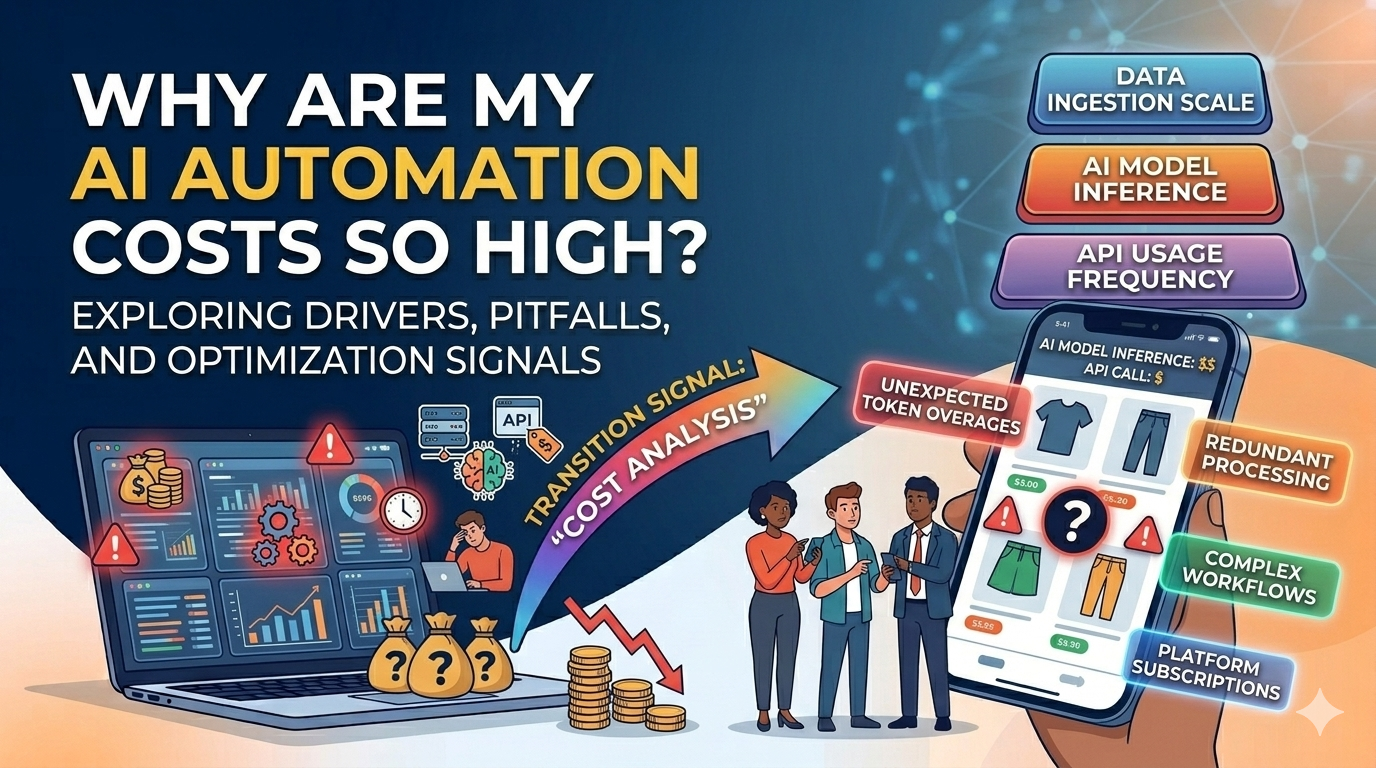
Reduce n8n AI token usage, CRM middleware cost optimization, expensive AI workflows
If your OpenAI or Anthropic bill suddenly feels out of control, the problem is probably not “AI being expensive.”
The real issue is much more specific:
Your middleware is re-processing the same intelligence over and over again.
This is the hidden cost trap behind many expensive AI workflows built on tools like
:contentReference[oaicite:0]{index=0}, custom CRMs, and API-based AI pipelines.
The Real Problem: AI Isn’t Expensive — Bad Workflow Design Is
Most business owners assume AI costs are driven by usage volume.
In reality, the biggest cost driver is:
- redundant context processing
- unoptimized middleware loops
- repeated prompt execution
- lack of caching strategy
Every time your system re-sends full context to an LLM, you are paying for the same intelligence twice — sometimes hundreds of times per day.
How Middleware Becomes a Silent Cost Leak
Modern CRM automation pipelines often look like this:
- incoming lead → AI summary
- support ticket → AI classification
- email → sentiment analysis
- chat → response generation
But here is the hidden inefficiency:
Each time the workflow runs, the system often:
- rebuilds full prompt context
- re-injects historical conversation
- reprocesses already analyzed data
This creates a continuous billing loop inside your AI provider account.
The Most Expensive Pattern: “Full Context Rebuild Every Time”
One of the biggest causes of token waste in CRM middleware cost optimization failures is this pattern:
Every workflow run reconstructs the entire conversation history instead of referencing a stored result.
For example:
- Lead comes in → AI summarizes profile
- Same lead updates → system resends full profile + previous AI output
- AI re-analyzes everything again
You are not paying for intelligence.
You are paying for repetition.
Where n8n and Similar Tools Quietly Waste Money
Platforms like
:contentReference[oaicite:1]{index=1} are powerful — but they don’t enforce cost optimization by default.
Common inefficiencies include:
- AI nodes triggered multiple times per event
- duplicate webhook executions
- no state persistence between steps
- lack of result caching
- unnecessary re-summarization steps
This is why teams trying to reduce n8n AI token usage often see minimal improvement without architectural changes.
The Core Issue: No Memory Layer Between AI Calls
Most expensive AI workflows fail because they behave statelessly.
That means:
- no persistent memory
- no result reuse
- no structured output storage
So even if the same lead was processed 10 minutes ago, the system behaves like it’s seeing it for the first time.
What Optimized AI Middleware Looks Like
A cost-efficient architecture introduces a memory-aware layer:
- store AI outputs as structured JSON
- reuse prior classification results
- only re-run AI when data meaningfully changes
- separate “analysis” from “retrieval”
This simple shift alone can reduce AI costs significantly in high-volume systems.
The Hidden Multiplier: Support Tickets and CRM Loops
The biggest cost explosions usually happen in:
- support ticket classification systems
- lead scoring automation
- email summarization pipelines
Why?
Because these are repetitive, high-frequency workflows that often reprocess identical or near-identical data.
Without optimization, every interaction triggers a full LLM call cycle.
How Businesses Accidentally 10x Their AI Bills
Here is the typical pattern:
- build automation quickly
- add AI at every step
- skip caching logic
- duplicate workflow triggers
- scale usage without monitoring token consumption
At that point, costs don’t grow linearly — they explode exponentially.
How to Actually Reduce AI Token Usage (Without Breaking Automation)
To fix expensive AI workflows, you need structural changes:
- introduce response caching per entity (lead, ticket, customer)
- store embeddings instead of raw reprocessing
- split workflows into deterministic + AI layers
- avoid full context injection for every call
- track token usage per node, not just total usage
This is where real CRM middleware optimization happens.
The Real Goal: Stop Paying for the Same Intelligence Twice
AI should answer new questions — not re-solve old ones.
If your system is repeatedly analyzing the same data, you are not scaling intelligence.
You are scaling inefficiency.
Why Work With Me?
I specialize in designing cost-optimized AI middleware systems focused on:
- reduce n8n AI token usage
- CRM middleware cost optimization
- high-volume AI workflow architecture
- LLM caching and memory design
- API-first automation systems
- enterprise-grade AI pipeline optimization
The goal is simple: make AI systems smarter and significantly cheaper to run at scale.
Frequently Asked Questions (FAQ)
Q: Why are my AI automation costs so high?
Because your workflows likely reprocess the same data repeatedly without caching or memory reuse.
Q: How can I reduce n8n AI token usage?
By adding caching layers, avoiding redundant prompts, and storing structured AI outputs for reuse.
Q: What causes expensive AI workflows?
Repeated context injection, stateless design, and unnecessary LLM calls in automation pipelines.
Q: Is n8n inefficient for AI workflows?
Not inherently — but it requires careful architecture to avoid redundant AI execution.
Q: What is CRM middleware cost optimization?
It is the process of redesigning automation layers to reduce unnecessary AI calls and infrastructure costs.
Get the Free Middleware AI Cost Leak Audit Checklist
If you want to identify where your system is silently wasting money, I’ve created a Middleware AI Cost Leak Audit Checklist.
It helps you detect:
- duplicate AI execution points
- missing caching layers
- token-heavy workflows
- redundant context rebuilding
📩 Request the audit checklist on Upwork
🎯 Get AI workflow optimization support on Fiverr