Why You Need to Hire an n8n Custom Node Expert for Enterprise Workflow Automation
When engineering teams initially deploy n8n for workflow automation, they naturally default to using the native HTTP Request node and standard JavaScript **Code** blocks. This architectural setup is fantastic for rapid prototyping and validating basic webhooks.
However, as workflows evolve to handle massive relational datasets, complex SaaS webhooks, and intricate multi-step enterprise operations, this visual-first development style hits a wall. Workflows become messy, unmaintainable “spaghetti maps,” API keys get exposed inside standard JSON canvases, and systemic execution overhead starts crashing your self-hosted instance.
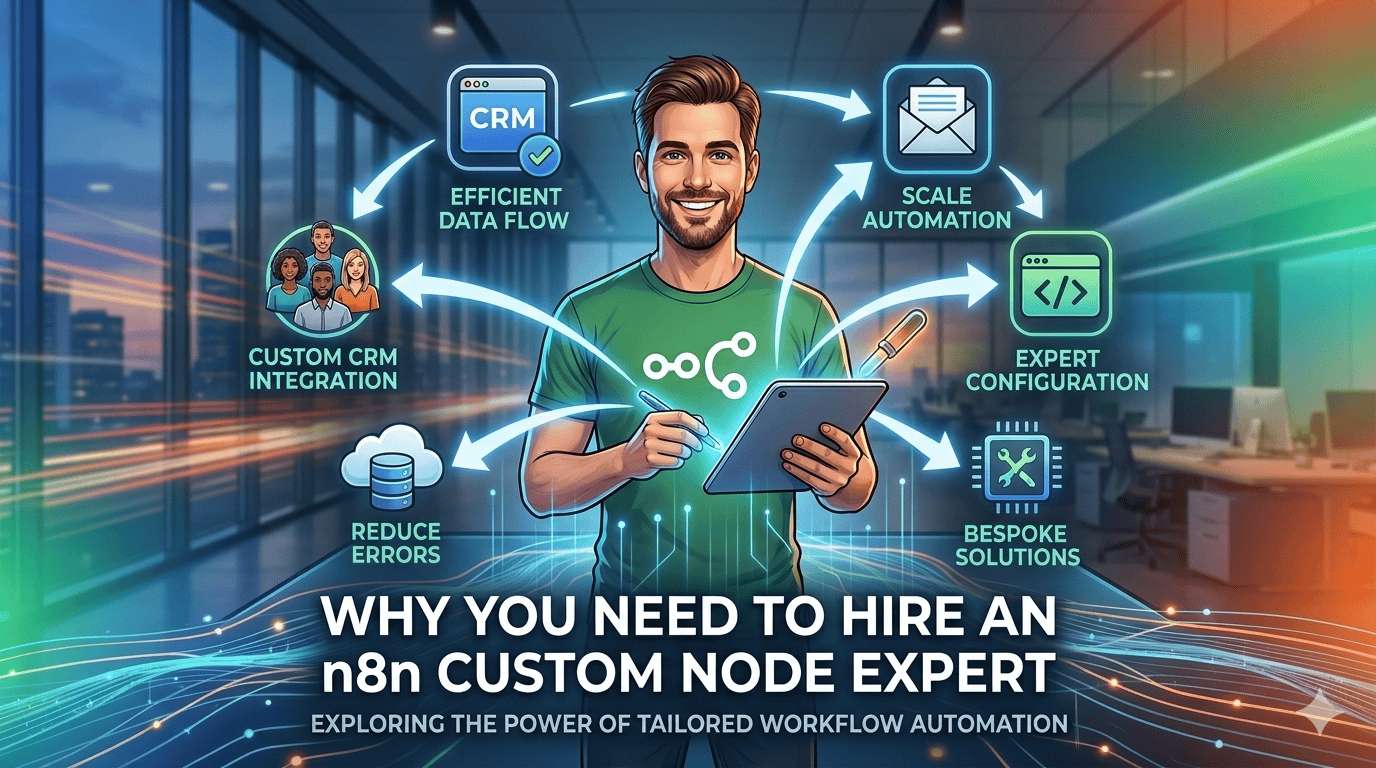
To scale operations safely and systematically, you need to transition away from generic canvas steps. This is the precise point where you must hire an n8n custom node expert to abstract your business logic away into modular, secure, and production-grade software extensions.
The Scaling Core Issue: Why Generic HTTP Nodes Fail at Enterprise Scale
Relying exclusively on native visual canvas wrappers to bridge proprietary business logic introduces massive long-term technical debt. While a standard endpoint call appears straightforward on paper, real-world deployment requires engineering resilience against real-world constraints.
If your production environments depend on dozens of sequential standard HTTP steps, your integration pipeline is vulnerable to specific operational risks:
- Fragile Payload Validation: Upstream software upgrades that modify API payload keys instantly break workflows across every canvas that manually references those strings.
- Scattered Authentication Tokens: Managing token parameters across multiple detached canvases creates massive security risks and complicates compliance audits.
- Uncontrolled Memory Leaks: Running large payload formatting transformations inside browser canvas visual states consumes massive amounts of RAM during multi-thousand item execution intervals.
- Inconsistent Error Management: Handling rate limits, network drops, and custom API error structures requires duplicating complex visual paths across every step.
By shifting focus toward **building custom nodes in n8n**, these architectural limitations disappear. Proprietary integrations are packaged cleanly into standalone TypeScript modules, transforming your integration layer from a collection of fragile UI patches into an enterprise-ready automation ecosystem.
What Is a Custom n8n Node and How Does It Transform Architecture?
A custom n8n node is a compiled software extension that plugs natively into the core n8n-nodes-base system architecture. Instead of assembling raw REST configurations visually, developers build specialized modules using TypeScript to define properties, UI inputs, data behaviors, and authentication configurations.
This approach moves integration complexities off your visual canvas and embeds them safely inside your codebase. The result is a clean, single node interface where users simply pick an action from a dropdown menu and populate structured fields, while your compiled backend code handles authorization, pagination, and error routing securely behind the scenes.
Declarative vs. Programmatic Nodes: Choosing the Right Development Blueprint
When architecting a custom n8n integration, an expert select from two distinct core implementation styles based on target API complexity:
| Development Approach | Underlying Technical Mechanics | Ideal Architectural Use Case |
|---|---|---|
| Declarative Style | Built using structured JSON-style routing objects. The node defines layout parameters and targets directly, relying on n8n’s native engine to execute the requests. | Standard REST APIs with predictable CRUD models, simple query inputs, and uniform JSON responses. |
| Programmatic Style | Built using complete TypeScript code execution methods. Offers absolute programmatic control over request lifecycles, execution buffers, and streams. | Complex APIs requiring dynamic encryption headers, binary stream handling, or multi-stage custom pagination systems. |
Choosing the incorrect engineering pattern early on leads to structural limits down the line. A seasoned developer knows exactly how to balance these methodologies—often wrapping declarative properties around programmatic helpers to build robust, maintainable components.
Three Critical Operational Milestones That Demand a Custom Node Solution
If your automation pipelines match any of the following technical indicators, patching existing flows with generic steps will no longer cut it:
1. Managing Multi-Stage Custom Pagination Cycles
Many legacy enterprise platforms and niche SaaS systems do not use standard Link headers or offset parameters for pagination. Instead, they require developers to extract a specific cursor token from the bottom of a response payload, pass it into a temporary cryptographic validation step, and inject it as a modified header attribute in the subsequent request loop. Building this pattern out using visual canvas loops creates messy, hard-to-track workflows. A custom node handles this entire pagination lifecycle programmatically in a compiled background thread, outputting a clean, unified array of items to the next step.
2. Centralized Enterprise Security & OAuth2 Lifecycles
Exposing raw API keys, client secrets, and bearer tokens across various canvas steps leaves your platform highly vulnerable to security leaks. Custom nodes separate authentication entirely by defining dedicated ICredentialType interfaces. This architecture routes all authentication mechanics securely through n8n’s encrypted database backend. Sensitive refresh loops, signature generation, and encryption routines happen behind the scenes, ensuring credentials are never exposed within the execution log canvas.
3. Complex Binary Data and Payload Transformations
Processing bulky file conversions, cleaning up messy nested arrays, or converting XML payloads into highly structured JSON formats inside standard browser canvas containers can quickly bottleneck system performance. Shifting this execution logic directly into a dedicated custom backend node lets you manipulate binary buffers using native Node.js streams. This drastically reduces server memory overhead and ensures smooth data processing across your entire infrastructure.
The Deployment Pipeline: Integrating Custom Nodes Securely into Your Infrastructure
Once a custom node is developed, it must be carefully packaged and integrated into your active runtime environments. A professional development deployment workflow follows strict infrastructure practices:
- NPM Package Distribution: Packaging the compiled TypeScript files into isolated, version-controlled npm packages (e.g.,
n8n-nodes-custom-service). - Docker Volume Mount Injection: Linking compiled distribution files into self-hosted Docker instances via localized
~/.n8n/custom/directories. - Environment Variable Enforcement: Configuring targeted cluster variables (such as
N8N_ENFORCE_SETTINGS_FILE_PERMISSIONS) to protect system access. - CI/CD Automated Testing: Implementing structured linting rules and regression testing to validate node performance before pushes hit live pipelines.
Operational Architecture Insight: Managing custom extensions through version-controlled npm modules ensures smooth, reliable instance restarts across distributed server setups, keeping your automation infrastructure fully synchronized.
Why Work With Me to Scale Your Automation Architecture?
I build clean, optimized, enterprise-grade automation infrastructures, specializing in moving companies away from brittle visual workarounds and transitioning them into stable, production-grade systems. My core development expertise includes:
- Advanced TypeScript development optimized for the core
n8n-workflowframework. - Building custom nodes in n8n for proprietary CRM solutions, internal inventory systems, and complex automotive or real estate APIs.
- Designing secure, centralized credential systems that handle multi-stage OAuth2 lifecycles.
- Optimizing system resources to resolve execution latency and server memory leaks.
- Managing professional distribution pipelines via private npm setups and custom Docker containers.
I focus on building clean, high-performance code, ensuring your business integrations scale smoothly without adding technical debt or inflating maintenance costs.
Frequently Asked Questions
Q: Why should I use a custom n8n node instead of the HTTP Request node?
While the HTTP Request node is great for fast prototyping, it exposes sensitive endpoint schemas, relies on manual error handling, causes workflow clutter, and struggles with complex multi-step pagination or dynamic token refreshes. A native custom node encapsulates all API properties, authorization states, and data schemas cleanly into a reusable UI component.
Q: Can custom nodes handle complex OAuth2 authentication?
Yes. Custom node credentials inside n8n leverage native credentials definitions. This natively manages OAuth2 authorization flows, token lifetime cycles, and automatic token refresh protocols without exposing raw credentials inside the execution JSON canvas.
Q: What language are n8n custom nodes built in?
They are written in TypeScript or JavaScript. They leverage the n8n-workflow framework and are distributed via standard npm packages, making them fully compatible with self-hosted Docker instances or native n8n Cloud environments.
Q: How does a custom node reduce n8n server resource usage?
By shifting heavy loop arrays, JSON payload transformation logic, and deep data mapping out of Code blocks and HTTP loops directly into compiled node source files, you drastically reduce execution execution overhead and prevent workflow memory leaks.
Accelerate Your Automation Pipeline Today
Stop fighting fragile workflow paths and complex visual canvas maps. Let’s build a clean, secure, and production-ready custom module tailored specifically to your operational demands.