
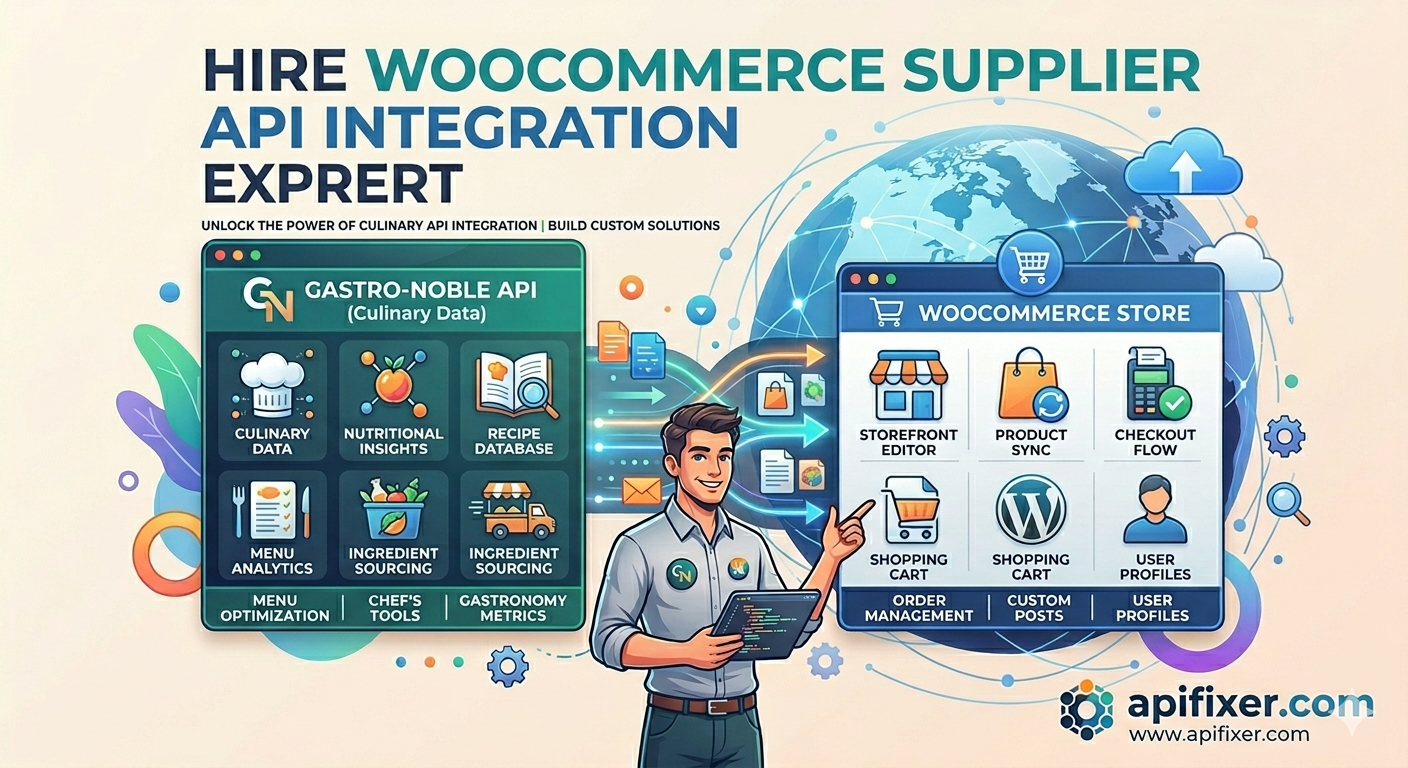
End-to-End WooCommerce Supplier Sync & Dropshipping Automation for UTTeam & Multi-Supplier APIs (WordPress Middleware Case Study)
Target Keywords: WooCommerce supplier API integration, UTTeam dropshipping WooCommerce plugin, product sync WordPress WooCommerce, inventory automation WooCommerce, order API WooCommerce dropshipping system
Modern WooCommerce stores that rely on supplier APIs are no longer simple “import products and sell” systems.
They are now fully automated data pipelines that must handle:
- real-time product synchronization
- variable product handling
- stock updates (in-stock / out-of-stock logic)
- product insert, update, and delete operations
- order forwarding back to supplier APIs
I recently built and deployed a full middleware-based WooCommerce synchronization system for a real production environment using:
- :contentReference[oaicite:0]{index=0}
- UTTeam supplier API
- multi-source product sync architecture
This type of system is ideal for businesses that need a stable WooCommerce supplier API integration + dropshipping automation pipeline.
Real Project Example: Textilbase WooCommerce Sync System
I implemented this system for:
The goal was to build a fully automated product synchronization system between WooCommerce and UTTeam supplier APIs.
The Core Problem
Most WooCommerce dropshipping setups fail at scale because they rely on basic import plugins that:
- re-import entire catalogs repeatedly
- don’t properly handle variable products
- fail to track deleted products
- lack intelligent stock comparison
- don’t support order automation back to supplier APIs
In this case, the requirement was more advanced:
- handle UTTeam variable products
- sync large product catalogs efficiently
- keep inventory accurate in real time
- automatically push orders back to supplier
The Solution: Middleware-Based WooCommerce Sync Architecture
Instead of connecting WooCommerce directly to the supplier API, I built a middleware synchronization layer.
This middleware acts as a control system between:
- UTTeam Supplier API
- WordPress WooCommerce store
- custom database sync layer
How the System Works
1. Supplier Data Extraction (UTTeam API)
The system pulls complete product datasets from UTTeam, including:
- simple and variable products
- SKU mappings
- stock availability
- pricing and attributes
- images and variants
2. Data Normalization Layer
Raw supplier data is inconsistent, so it is normalized into a structured WooCommerce format.
This includes:
- attribute mapping
- variation grouping
- SKU standardization
- stock logic normalization
3. Hash-Based Change Detection System
To avoid unnecessary processing, every product is stored in a hashed format inside a custom database table.
This allows the system to detect:
- new products → insert
- changed products → update
- missing products → delete
- unchanged products → skip
This is critical for performance when handling large catalogs.
4. Insert / Update / Delete Sync Engine
The WooCommerce database is updated intelligently:
- new products are created automatically
- existing products are updated only if changes are detected
- removed supplier products are deleted or disabled in WooCommerce
This ensures the storefront always matches supplier reality.
5. Inventory Synchronization (Real-Time Stock Logic)
Stock levels are continuously synced from UTTeam API.
The system automatically updates:
- in-stock products
- out-of-stock products
- variation-level stock availability
This prevents overselling and improves customer trust.
6. Variable Product Handling (Advanced Mapping)
One of the most complex parts was handling UTTeam variable products.
The middleware ensures:
- correct parent-child product relationships
- attribute consistency across variations
- SKU-level stock mapping
7. Order Forwarding to UTTeam (Dropshipping Automation)
When a customer places an order on WooCommerce:
- order data is captured
- products are mapped to supplier SKUs
- order payload is generated
- order is posted back to UTTeam API
This enables fully automated dropshipping fulfillment.
🔗 Example integration reference (WooCommerce API approach):
Products Sync for WooCommerce Plugin (similar architecture reference) :contentReference[oaicite:1]{index=1}
Why Middleware Architecture Matters
Most plugins try to solve this with direct API syncs.
But at scale, that approach breaks due to:
- API rate limits
- slow cron-based updates
- lack of change tracking
- high server load
A middleware layer solves this by acting as a data intelligence engine:
- reduces API calls
- optimizes update cycles
- filters unnecessary operations
- ensures consistency across systems
Comparison: Basic Plugin Sync vs Middleware System
| Feature | Basic WooCommerce Plugin | Middleware Sync System (This Solution) |
|---|---|---|
| Product sync method | Full re-import | Delta (hash-based updates) |
| Variable products | Limited / unstable | Fully supported mapping engine |
| Stock updates | Delayed / cron-based | Near real-time sync |
| Order forwarding | Often missing | Fully automated API push |
| Scalability | Low | High (optimized middleware) |
Who This Solution Is Built For
This system is ideal for:
- WooCommerce dropshipping businesses
- supplier API integrations (UTTeam, CSV, XML, REST)
- multi-vendor inventory systems
- wholesale WooCommerce stores
- high-volume product catalogs
Related Work
I also built similar systems for:
- Miogest CRM WordPress synchronization
- Gastronoble WooCommerce dropshipping automation
- real-time inventory sync architectures
🔗 Miogest CRM integration case study:
https://apifixer.com/miogest-crm-wordpress-plugin/
Why Work With Me?
I specialize in building advanced:
- WooCommerce supplier integrations
- dropshipping automation systems
- API middleware architectures
- real-time inventory sync solutions
- custom WordPress plugin development
My focus is not just importing products — but building scalable, production-grade automation systems that eliminate manual work entirely.
Frequently Asked Questions (FAQ)
Q: Can WooCommerce handle UTTeam supplier APIs directly?
Yes, but direct integration does not scale well. Middleware improves reliability and performance.
Q: How are variable products handled?
Through a structured mapping system that maintains parent-child relationships and SKU-level inventory tracking.
Q: Does the system support real-time stock updates?
Yes, stock is continuously synchronized and reflected in WooCommerce.
Q: Can orders be automatically sent to the supplier?
Yes, orders are forwarded to UTTeam API automatically after checkout.
Q: Is this scalable for large catalogs?
Yes, hash-based delta syncing ensures performance even with thousands of products.
Need a Custom WooCommerce Supplier Integration System?
If you are looking for:
- UTTeam WooCommerce integration
- supplier API dropshipping system
- real-time inventory synchronization
- custom WooCommerce middleware development
- scalable product sync architecture